

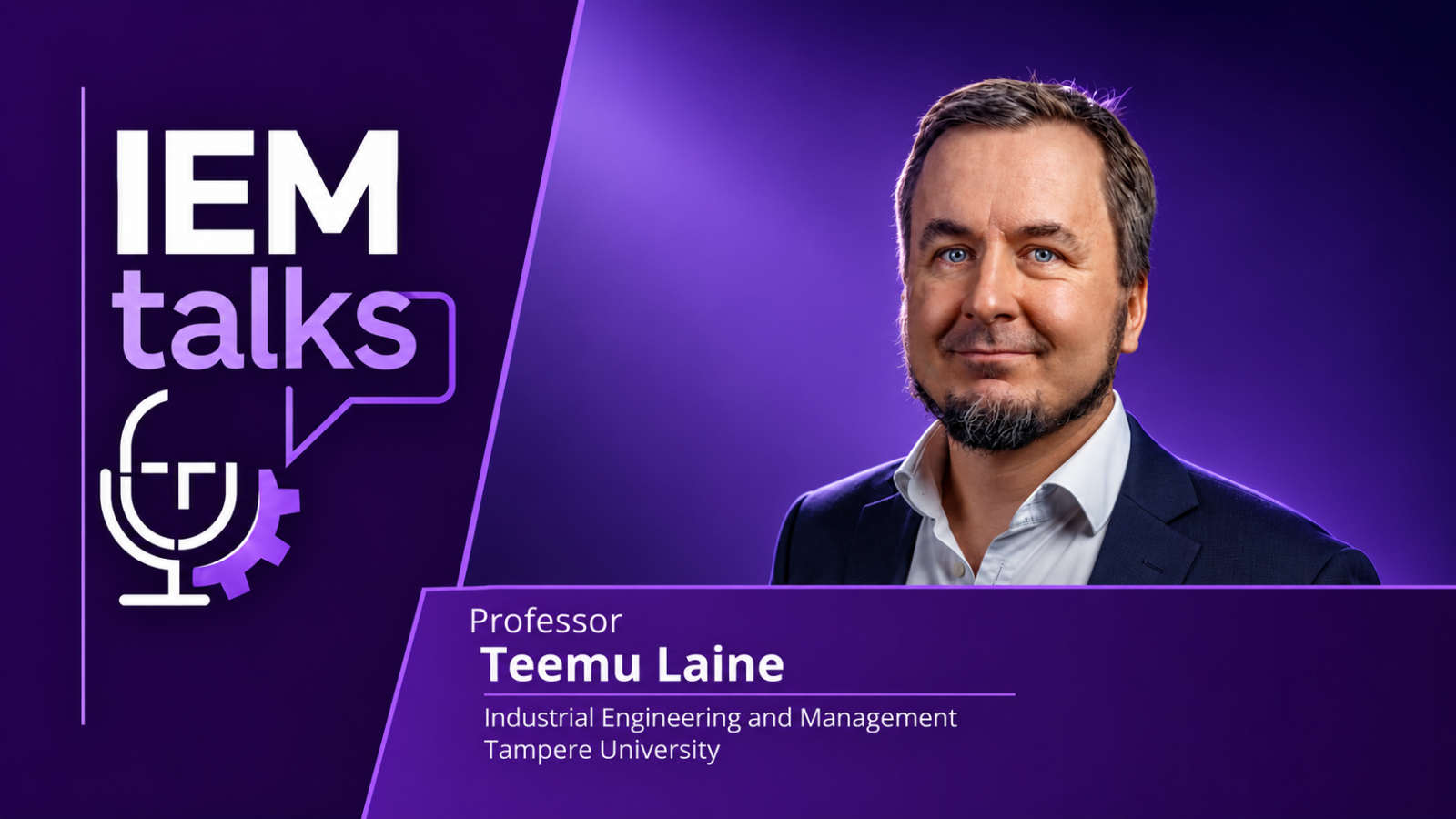
Teemu Laine
Professor, Industrial Engineering and Management, Faculty of Management and Business
Tampere University
You have been part of Industrial Engineering and Management at Tampere for more than two decades. How would you describe your journey from student and researcher to professor and leader of the Cost Management Center research group?
Teemu Laine: I have always been curious and eager to learn new things. Even as a student, I was already considering doing a doctoral dissertation, which was quite uncommon among Industrial Engineering and Management students in the early 2000s. Alongside my studies, I worked as an assistant on a basic course, and soon after graduating I joined the CMC research group. There, I have learned about conducting research and teaching, and perhaps most importantly, I have gained a deeper understanding of management.
One of the most important stages on my path toward becoming a professor was my Academy of Finland postdoctoral researcher project. It allowed me to carry out my own project and also spend a longer period abroad as a visiting researcher. At that time, I worked under the titles of university lecturer and university researcher, and gradually grew into the role of leading a research group.
I have had quite a lot of responsibility for acquiring external research funding, and I have also been in a supervisory role for a long time. I enjoy teaching and supervision as well. At the same time, I have wanted to clarify my own vision and think carefully about what I want to focus on and which issues I want to take forward. This often requires reducing and prioritizing tasks and concentrating on what is essential.
Let us go a little deeper into your research interests. What originally attracted you to management accounting, profitability management, and industrial service business?
Teemu Laine: In Industrial Engineering and Management, I have been particularly fascinated by real processes: what we do and what follows from our actions, both economically and in other ways. Finance is one language through which these processes can be described, and it provides tools for understanding things in detail. During my studies, I particularly enjoyed courses related to financial and economic topics.
The topic of my doctoral dissertation came from a CMC Tekes project, Tekes being the predecessor of the current Business Finland, where we examined the service business of an industrial company particularly from the perspective of its profitability implications. At the time, we considered value creation broadly: an activity needs to be worthwhile for both the customer and the supplier in order to be sustainable.
During my doctoral research, we examined the concept of service in considerable depth so that we could also build economic analyses on that understanding. If we define service as doing something for another party, the analysis immediately becomes connected to what follows from that activity and what kinds of costs and other effects are associated with it.
Over the years, your research has covered management accounting, industrial services, project portfolios, performance measurement, digitalization, artificial intelligence, sustainability, and customer value. What connects these different areas?
Teemu Laine: In addition to general curiosity, my research is connected by a desire to understand the effects of decision-making and action. In particular, I am interested in how we can influence these effects through management and control.
This kind of research is needed in areas that are undergoing change, involve uncertainty, or are complex and unclear. This is what connects the different areas mentioned.
Over the past ten years, roughly since 2015, themes related to well-being and environmental sustainability have become increasingly visible alongside the economic perspective. They challenge and deepen economic analyses. This is very clearly reflected in our current projects, and I hope it will become increasingly visible through our publications as well.
Much of your research appears to begin with a real problem faced by a company or another organization. How do you identify a topic that is both practically useful and academically interesting?
Teemu Laine: During my doctoral project, a company expressed a wish for new perspectives on developing its service business. My colleague and supervisor suggested developing a business game in which the players try to make their customer company as valuable and profitable as possible. As part of my doctoral research, I developed the financial calculations for this game, and the game was played in several countries over a period of more than three years. An academic article was also published based on the game, and Emerald later gave the article an award.
More generally, many new and challenging management questions have the potential to become research topics and can also lead to significant academic contributions. Sometimes companies want quick results, such as financial analyses or new tools. For researchers, these needs can provide access to much deeper data than would otherwise be possible.
We have been able to participate in real, large-scale transformation programmes and product development projects because our presence was considered useful. Although the data available in these settings are much deeper than usual, this approach requires considerable time, because sometimes the right research question only becomes clear later in the process.
You have worked extensively with interventionist research and pragmatic constructivism. If you were to explain these approaches in simple terms, what can researchers understand through them?
Teemu Laine: Interventionist research is an umbrella concept for different kinds of research in which the researcher becomes involved in the research setting and actively influences the object of study. During the research process, conceptual and theoretical reflection alternates with practical action. In this way, the researcher develops a deep understanding of the phenomenon theoretically, but also as a societal phenomenon or as an object of technical development.
Interventionist research can be conducted in many different ways, ranging from active participation in meetings to involvement in the implementation of larger transformation programmes. What is essential is that an interventionist approach provides access to exceptionally rich and in-depth data about the research setting.
The precise research question may already be known in advance, or it may emerge and become more specific during the process. In principle, both the researcher and the organization benefit.
In pragmatic constructivism, the world is viewed from the perspectives of different actors and people. People’s actions are particularly influenced by their values, through which the facts in the world appear differently to different people. As a result, we also naturally recognize possibilities in different ways.
Communication is a central connection and bridge between people. Pragmatic constructivism examines functioning practices that people influence both consciously and unconsciously. For this reason, the approach fits well with Industrial Engineering and Management and with interventionist research. We actively collaborate with the scholars who developed this approach.
One recurring idea in your work is bringing facts and feelings together in decision-making. How did this become an important theme for you?
Teemu Laine: That is a broad question. It is particularly important to see people as whole human beings. It would be important for people to be able to be themselves at work as well.
Feelings can influence decision-making in many different ways. We may make a choice first and develop the justification afterward, or the calculations we make may include or exclude certain perspectives based on our own preferences. We may frame a decision-making process as rational even when it is not actually rational.
Financial performance is also not the only goal or objective of decision-making. Organizations should seek sustainable solutions that increase well-being so that the conditions for their activities can also be maintained in the future.
From an individual perspective, it is important to work in an environment whose values you genuinely believe in and where you can therefore also pursue your own vision through your work.
Environmental sustainability, biodiversity, green business, and the commercial feasibility of sustainable solutions have become increasingly visible in your recent research. How do you see the relationship between sustainability and profitability?
Teemu Laine: In many cases, an environmentally sustainable solution is also financially profitable. We use fewer resources, choose solutions that are more sustainable and more valuable to the customer over the long term, and take care of our operating environment.
In some cases, however, these perspectives are seen as conflicting because more sustainable alternatives are more expensive and it can be difficult to find someone willing to pay for them. Management accounting can help by providing terminology and, for example, investment logic to support decision-making.
Looking only at the purchase price today is very different from considering the overall impact over a period of five or ten years. It is also possible that even maintaining the current level of performance will require a transition toward more sustainable solutions.
Management accounting can also help organizations set sufficiently ambitious goals for environmental sustainability. It is often not enough to choose the environmentally “least harmful” option among the cheapest alternatives if the objective is, for example, to reduce emissions.
We should have the courage to calculate the overall effects even of solutions that we consider environmentally sustainable and consider which solutions would actually be sustainable, as well as what their development and implementation would cost.
You have worked as a professor, degree programme leader, research group leader, doctoral supervisor, journal editor, reviewer, and board member. How have these different roles changed your understanding of leadership?
Teemu Laine: Overall, the diversity of academic work is exciting and inspiring. In many of the roles mentioned, an essential part of the work has been discussing what the current situation is and what the jointly understood steps toward the future should be.
It has been a privilege to grow as an expert through different responsibilities. Many roles are learned through practice. Working as a journal editor and reviewer teaches you not only how to evaluate other people’s publications, but also how to see and conduct your own research in new ways.
Within a research group, it is important that everyone has the space and opportunity to take on the kinds of tasks they want and to have as diverse a range of responsibilities as possible. I have tried to encourage people to take on new kinds of tasks, although, of course, it is also important to make sure that the overall workload remains manageable.
The secret to the long-term success of a research group lies in its people, in achieving a suitable balance between continuity and change, and in having a willingness to see the group as something shared, where everyone has the opportunity to pursue their own ideas.
Leading a research group is somewhat similar to coaching. It is important to allow people to make their own decisions and succeed through them.
International and long-term collaboration has been an important part of your career. Which collaborations have influenced you most, and what have you learned from them?
Teemu Laine: Among international universities, Scuola Superiore Sant’Anna in Pisa has undoubtedly been one of the most influential. We have collaborated with them for around 20 years. Aarhus University has also been very important, with collaboration continuing for approximately 15 years.
These collaborations began through shared research interests, but also through similar ways of seeing the world on a personal level. This allows us to renew ourselves together and also contribute to renewing our research areas. Although we have collaborated, and continue to collaborate, internationally with many other partners, we are currently preparing new projects with both of these universities.
I have collaborated with dozens of companies. Sandvik was the first and is therefore worth mentioning. In recent years, our partners have increasingly been professional service firms, partly because our research topics have also changed.
Collaboration naturally involves challenges as well. Constructive criticism from companies can help generate new ideas. At the same time, we want to make sure that we receive sufficient data and have the other conditions needed to succeed in our research.
You have received several Emerald Literati recognitions, and some of your publications have received many citations. How do you personally assess whether a research project or publication has been successful?
Teemu Laine: The most important aspect of a publication is its content. Naturally, certain publication outlets reach larger audiences, and publishing in them can increase the impact of research in this way. At the same time, this increases the responsibility associated with the content and the message conveyed by the article.
With some articles, such as the business game article mentioned earlier, we changed the publication outlet after receiving a quick rejection. The article was eventually published in the new journal and was later given an award.
There are also a couple of other articles that I am proud of because of the concepts they introduced, such as “boundary subject”, and the way of thinking they presented, such as “overcoming ambiguities”. At the same time, I recognize that certain keywords or publication forums can make it easier to generate citations.
I have seen changes in companies’ strategies, product choices, and customer relationship management connected with my research projects. Very often, new ways of thinking about and calculating the effects of activities have remained in use.
Sometimes I am also surprised by how slowly things change. Ideas related to developing service business and profitability that we discussed two decades ago are still sometimes presented as relatively new ideas.
Digitalization, artificial intelligence, automation, and digital twins are becoming increasingly visible in your recent research. How do you think they will change management accounting and managerial work?
Teemu Laine: In management accounting, many things can be developed, made more efficient, and automated. An interesting feature of the field is that it brings together some of the easiest things to automate, such as data collection and classification, and some of the most difficult things to automate, such as strategic choices and human decision-making.
For this reason, the balance between these two extremes is likely to remain a highly relevant and important research topic for a long time. At some point, the collection of certain basic information will become extremely efficient, which could allow decision-making and the discussions surrounding decisions to develop to a more advanced level.
Looking back at your career, what has been a turning point that changed your direction or your way of thinking?
Teemu Laine: There have been several turning points. Things are often the result of a combination of circumstances. Although I was already aiming toward doctoral research as a student, I certainly could not have imagined all the stages that would eventually bring me to this point.
The journey has also included a great deal of joy and happiness in my personal life, as well as challenges. I would not really do anything differently. At some points, I worked too much, and perhaps now I would think that even with a more moderate schedule, there is enough time to accomplish the things that really matter.
After completing my doctoral dissertation, people trusted me and I was able to continue working at the university. This created an opportunity to shape my work in my own way and begin preparing projects with broader responsibilities.
After the Academy of Finland project, applying for a tenure track position was a natural next opportunity, and fortunately I was selected. I received considerable responsibility for the research group relatively early and later took on administrative responsibilities as well.
I would say that, in addition to making life busy, these responsibilities also established my role within the unit, the university, and our collaboration networks. As I progressed along the tenure track, I gained more space to think about things through my own perspective, my own vision, and broader plans for the future. I hope this also benefits the university.
Finally, what advice would you give to Industrial Engineering and Management students and researchers at the beginning of their careers?
Teemu Laine: Over the years, I have admired many colleagues in Industrial Engineering and Management and elsewhere. I think the broad nature of our field gives us a great opportunity to open doors that genuinely interest us. Open-mindedness is a good companion to this breadth.
The best starting point is to think about what you genuinely want and what choices you need to make to achieve it. I see the tremendous expertise that students and colleagues have. It is worth putting that expertise to use in pursuing the vision that you have identified for yourself.