

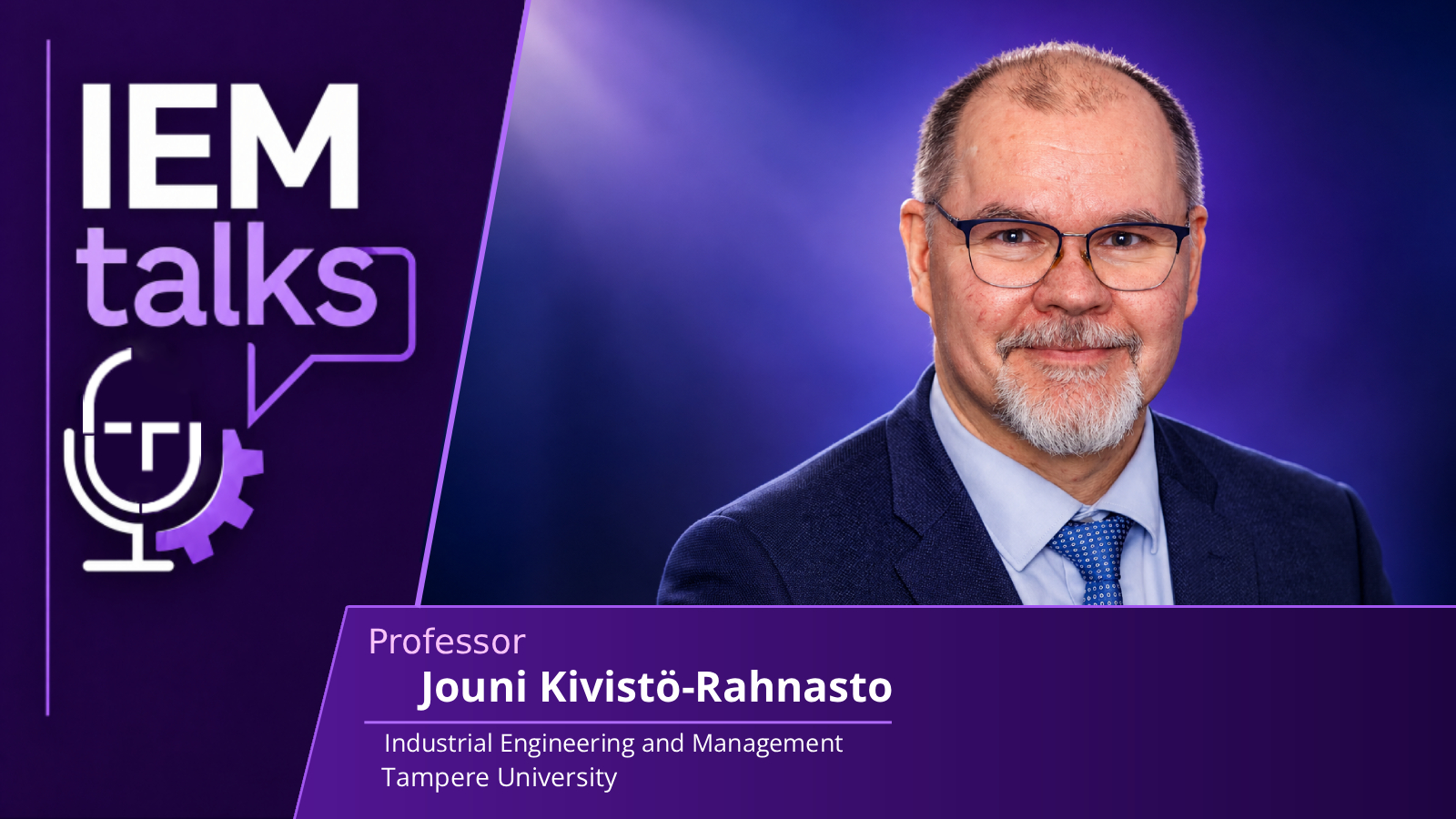
Jouni Kivistö-Rahnasto
Professor of Safety Engineering
Unit of Industrial Engineering and Management
Faculty of Management and Business
Tampere University
Professor Jouni Kivistö-Rahnasto of Tampere University discusses his career, changes in safety research, collaboration with working life, and what decades of experience have taught him about research, management and learning.
Jouni, you have been part of the Tampere university community for a long time. Where did your career actually begin?
Jouni Kivistö-Rahnasto: In fact, I have worked in the Tampere university community for almost 30 years, and at VTT Technical Research Centre of Finland for about six years. I started as a research assistant at Tampere University of Technology (TTKK) back in 1993. Finland had just fallen into a historically deep recession, and at the time I was considering whether to pursue a traditional engineering job or continue my education.
I had written my master’s thesis on a personnel lift that Bronto Skylift was planning for the US market. Through that work, I became familiar with product liability, safety risk analyses, reliability engineering and the role of human cognition in safety. I also had an opportunity to take postgraduate courses in the United States. In the end, the recession, chance and good timing played a decisive role in the direction my career took.
How did your master’s thesis and the changes in European machinery safety requirements influence the direction you took?
Jouni Kivistö-Rahnasto: At the time, European Community (EC) countries were preparing for the free movement of machinery within the common market. This required products to be safe and their safety to be demonstrated in accordance with the Machinery Directive. The change also had a major impact on Finnish companies, although its significance was not yet fully understood. By chance, I had already become familiar with these new European requirements while working on my master’s thesis, and I realised that they offered many opportunities for continuing education, consultancy and research.
Together with the continuing education centre at TTKK, we began training company personnel in how to apply the Machinery Directive. The demand for my expertise grew rapidly as 1995 approached. Companies began to realise that they could not export their machines to the EC and European Free Trade Association (EFTA) area without complying with the Machinery Directive. Training alone was often not enough; more in-depth expert support was needed. This led to the development of a broad network of companies, and through my work with them I combined training, consultancy and research. At the same time, I collected data for my doctoral dissertation.
How have the focus of your research and the work of a researcher changed over these decades?
Jouni Kivistö-Rahnasto: Over the years, the focus of my research and development work has shifted from technical safety risk analyses to ergonomics, risk management in industrial services and, eventually, broader corporate risk management. What has remained constant, however, is the use of risk analyses and the development of solutions to practical problems and needs. The smallest thing I have worked on was a smartwatch, as early as 1999, and the largest was a nuclear power plant.
The biggest change over the past 30 years has been the shift from company-driven research towards a stronger emphasis on internationally peer-reviewed research. Previously, research findings were most often reported directly to the companies funding the research, whereas today the expectation is that the results will appear primarily in international scientific publications.
In my own work, I have tried to follow the principle that a researcher should be active in at least two of three areas: scientific research, collaboration outside the university, and teaching. Which two have played the main role has varied at different stages of my career.
Your education was originally strongly rooted in mechanical engineering. How did you become interested in safety engineering and eventually begin looking at management as well?
Jouni Kivistö-Rahnasto: My background is in mechanical engineering, in which I hold a master’s degree in engineering. My major was machine design, and my minor subjects were engineering mechanics, hydraulics and automation. Before I began my master’s thesis, Professor Markku Mattila and I also agreed that I would complete a particularly short minor in safety engineering. Although I did not originally have a background in safety, I was immediately fascinated by how risk analyses could be used to understand complex systems made up of people and machines. My mechanical engineering studies provided an excellent foundation for understanding how systems work, and against that background conducting risk analyses felt natural.
Realising the strategic importance of the Machinery Directive for companies in the mid-1990s led me to study legislation more broadly. I often found myself helping lawyers on the other side of the table understand how a directive concerning technology actually works in practice. The Machinery Directive was also closely linked to European standardisation. At the same time, various management system standards were developing, now known, for example, as the ISO 9000 family for quality management, ISO 14000 for environmental management, ISO 27000 for information security management, and ISO 45000 for occupational health and safety management.
What role did your years at VTT play in broadening your perspective from individuals to the way organisations operate?
Jouni Kivistö-Rahnasto: During my years at VTT, I worked on projects involving, among other things, the use of futures research methods in product development and the development of digital services that users would consider trustworthy. At the same time, my understanding of foresight and of how people perceive things and behave expanded from the study of individual cognition to an understanding of how groups and organisations operate.
Put simply, my path took me from mechanical engineering to risk analysis, from risk analysis to legislation, from legislation to standards, and from standards to management systems. Eventually, I found myself asking what management actually is and how threats and uncertainties are taken into account in decision-making.
Looking back at your research, how has your understanding of safety changed?
Jouni Kivistö-Rahnasto: Early in my career, safety was primarily a technological question for me: how could equipment failures or problems arising during its use lead to serious accidents? Over the years, my perspective has broadened to consider how organisations can operate sustainably and responsibly without causing harm to people, the environment or property.
Good examples of the different dimensions of risk are the ammonium nitrate explosion at the Port of Beirut in 2020, which, in addition to causing deaths, damaged or destroyed the homes of hundreds of thousands of people, and Fortum’s unsuccessful investment in Uniper, which resulted in financial losses amounting to billions. Risks, therefore, are not merely operational or technical problems; they often have a strategic dimension as well.
How have threats to safety and security changed from the perspective of companies and society?
Jouni Kivistö-Rahnasto: The focus of safety has also changed. Alongside the traditional prevention of harm and accidents (safety), protection against intentional harmful acts (security) has become increasingly important. At the same time, our entire operating environment has changed. Geopolitical tensions complicate supply chains, disrupt international trade and create threats involving state actors in ways that seemed remote to many people just a few years ago. These risks are now part of everyday life for businesses and society.
Safety therefore no longer means only preventing accidents. Increasingly, it means being able to cope with new situations and to identify and manage threats and uncertainties that could jeopardise an organisation’s objectives and ability to operate, or, at the broadest level, even the stability of society.
You have described yourself as a practical engineer with a strong connection to working life. How do real workplace problems become research questions for you?
Jouni Kivistö-Rahnasto: I have never seen a conflict between practical problems and science. Quite the opposite, in fact. Engineers characteristically solve practical problems using scientific methods. I have always been interested in phenomena and in what we do not yet know about them. Research questions arise from practical phenomena when we ask what else it would be important for us to know. We then look for answers to those questions using scientific methods.
Another perspective is that we are often missing something we need. In that case, the primary task is not to answer a research question but to develop a solution to an identified need. To me, this is at the heart of engineering research: identifying and studying needs, developing solutions and evaluating how well they work.
Has the position of practice-oriented engineering research changed within universities?
Jouni Kivistö-Rahnasto: In my view, engineering universities have partly lost their engineering identity over recent decades as publishing in peer-reviewed scientific journals has become more important. To put it somewhat provocatively, one could say that engineering research has adopted approaches typical of the social sciences and humanities, partly because engineering’s own research approaches and methods have not always been sufficiently recognised or valued. The central task of engineering research, however, is not only to produce new knowledge but also to develop new solutions and demonstrate that they work.
Much of your research in recent years has focused on occupational health and safety risk assessment. Where do organisations still go wrong?
Jouni Kivistö-Rahnasto: I distinguish between risk analysis and risk management. Problems with risk analyses include, for example, insufficient knowledge of methods, choosing the wrong method, poor organisation of the analyses, misconceptions about the amount of work they require, and carrying them out superficially or mechanically. Inadequate documentation of the results, difficulties in communicating them and poor communication also often cause problems. One key shortcoming is that people have not received enough training in conducting risk analyses, and competence is not developed systematically.
The internet is also full of methods whose effectiveness has not been validated. For example, research evidence suggests that the widely used risk matrix is a poor method for assessing the magnitude of risk and supporting decision-making in many applications. The motivation for conducting a risk analysis may also be simply to fulfil documentation or compliance obligations. In such cases, the results may not even be intended to support operational improvements or decision-making.
Why are known risks not always addressed, and what does successful risk management require in your view?
Jouni Kivistö-Rahnasto: Accidents and business losses are often caused by factors whose existence was already known. Failure to address them is frequently linked to an organisation’s values, culture and ways of working. On the other hand, losses can also result from active errors, technical failures or latent conditions that have developed over a long period.
Rather than dwelling on mistakes, it is more useful to focus on how to do things correctly. Successful risk management requires vision and clear commitment from management, the integration of risk management into management practices, clearly defined responsibilities, and effective, validated analysis methods and information systems. Training, expert support, evaluation of results and continuous improvement are also needed. In other words, the basics of good management.
What has been the most important turning point in your career?
Jouni Kivistö-Rahnasto: The most important turning point in my career was my master’s thesis and the immediate enthusiasm it sparked for using risk analysis to support design. It was also then that I met Professor Markku Mattila, who has had a significant influence on what I have studied and how I have learned to approach things. Another important turning point was starting my postgraduate studies and realising that I was no longer studying to pass an exam, but to learn and understand.
How did working at VTT and becoming a professor affect the way you see your role?
Jouni Kivistö-Rahnasto: Working at VTT differed from working at a university, particularly in that universities convey research findings to society not only through scientific publications but also through teaching and lifelong learning. Universities therefore have a particularly important channel through which research can have an impact on society.
Being appointed professor also changed my perspective. Instead of focusing on individual research questions, I began paying more attention to developing the field as a whole and understanding and strengthening its wider significance for society. At the same time, my own role has gradually shifted from that of a researcher towards being more of a mentor, someone who makes things possible and supports
You have conducted research with companies and many different public organisations. What have you learned about the differences between these environments?
Jouni Kivistö-Rahnasto: Organisations are made up of people, and it is a pleasure to work with them. The work people do is important in both the private and public sectors. One difference, perhaps, concerns the resources available for development. Companies typically invest more in various development projects than public organisations do. The approaches and methods taught in engineering fields may also help provide the skills needed to organise and carry out development work in practice.
However, it is not simply a question of whether an organisation is public or private. The size of an organisation also has a significant effect on its opportunities for development. In smaller organisations, development may be constrained by both financial resources and the expertise available.
What kinds of collaboration have you found particularly rewarding?
Jouni Kivistö-Rahnasto: I have also done many things pro bono. Sometimes, with a relatively small investment of time, I have been able to help a small company solve a significant problem that it may have considered difficult for a long time. Situations like these have been particularly rewarding because you can often see the practical impact of your work immediately.
You also served as President of the Finnish Union of University Professors for two terms. What did that experience give you?
Jouni Kivistö-Rahnasto: I did indeed serve as President of the Finnish Union of University Professors for two terms. The Union both brings professors together and represents their interests, while also working to improve the conditions for scientific research. In the first of these roles in particular, I had the opportunity to meet professors from more disciplines than I had previously even known existed. Those discussions broadened my worldview considerably.
The role also took me into areas that are not usually the first things associated with mechanical engineering. For example, I chaired the Union’s history committee, which worked on Mika Kallionen and Sami Louekari’s book Tiedossa tulevaisuus: professorit uudella vuosituhannella. I also chaired the Union’s investment committee, which planned and guided the management of its financial assets.
What kind of work to influence public policy did that role involve, and what did you find most meaningful about it?
Jouni Kivistö-Rahnasto: Working to influence public policy was demanding but also extremely rewarding. I appeared on television, radio and in the press to promote the conditions needed for science and research. I also gave evidence to committees of the Finnish Parliament on science policy matters, often concerning funding for research and higher education. Key people at the Ministry of Education and Culture and the Ministry of Economic Affairs and Employment were also important partners.
It was particularly rewarding to see that long-term advocacy led to concrete commitments being included in government programmes and, through them, improvements in the conditions for science and universities.
Your career began at a time when today’s digital technologies were not as prominent as they are now. How has automation changed safety?
Jouni Kivistö-Rahnasto: I’m not quite so old that digital technology did not exist when I started my career. I did, however, get to see the emergence and spread of World Wide Web technology in the early 1990s, as well as mechanical variable-speed transmissions being replaced by variable-frequency drives for electric motors. On the whole, fairly advanced automation already existed at that time. Today, of course, it is many times more advanced and, above all, smaller.
In fact, the first scientific article I was involved in was entitled Fatalities at Advanced Automation and FMS Installations. Overall, advanced automation has improved safety, and I believe this development will continue in the future.
How has digitalisation changed your own work as a researcher?
Jouni Kivistö-Rahnasto: Digital technology alone has radically changed the work of researchers. When I was writing my doctoral dissertation, practically all the source material was on paper. I would request interesting articles through interlibrary loans and might wait two months for them, only to discover that the article did not cover what I had expected. At least I had already written my master’s thesis on my own laptop PC, which had cost an absolutely astonishing amount of money.
What do you think about the significance of artificial intelligence for safety and the new requirements that technology brings?
Jouni Kivistö-Rahnasto: Artificial intelligence is an interesting issue from a safety perspective. AI has been used to control machines and industrial plants for decades. It is easy to fall under the illusion that AI is something new when generative AI is treated as synonymous with AI as a whole.
AI will change technology in many ways. In a sense, however, I find myself back where I started my career: the new EU Machinery Regulation, due to enter into force next January, introduces explicit safety requirements concerning both AI used in machinery and information security for the first time. The situation is interestingly similar to the early 1990s, when new European machinery legislation was just about to become part of companies’ everyday operations.
You have taught and supervised students and researchers for many years. What advice would you give to an industrial engineering and management student or doctoral researcher at the beginning of their career?
Jouni Kivistö-Rahnasto: Study things that you find meaningful. You can also choose to do something different from what dozens of people around you are doing. Practise your skills, because simply knowing things is not enough. You also need to be able to apply what you know and get things done. In the age of AI, this is even more important.
To students in general, and doctoral students in particular, I would say that the process itself also helps you grow. Everything does not have to be as efficient or straightforward as possible, because learning often happens along the way. Sometimes detours are part of learning, too.
What would you say to someone deciding between an academic career and a career in industry? Looking back at your own career, would you do anything differently?
Jouni Kivistö-Rahnasto: Many people consider whether to pursue an academic career or a career in industry. I would tell them that the two are not opposites. On the contrary, at their best they can complement each other, and both can easily be part of the same career.
I am satisfied with my own career as one part of my life. Wise people learn from other people’s mistakes; fools do not even learn from their own. You cannot go back to the past, but you can learn from it. That is why it is better to focus on what you can still do than on what you could have done differently.