
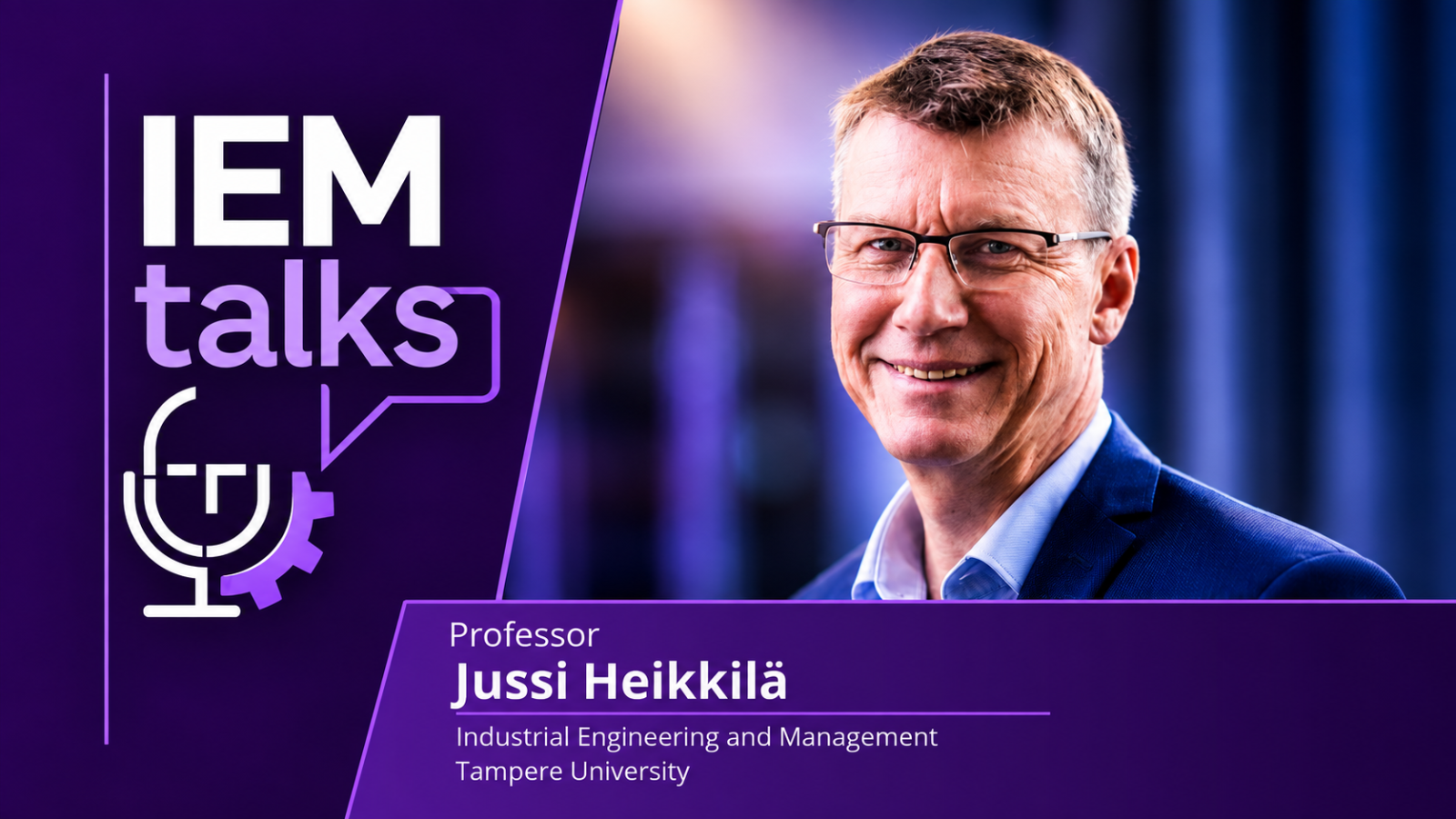
Your career has not been a typical academic path. How do you perceive your career when looking back?
I retired and became a professor emeritus of industrial engineering and management in 2025. I had been in the workforce for almost 50 years by then. I spent my last ten working years at Tampere University as a professor of production and operations management.
My career has not been a very common university path. I worked my first paid jobs as a construction site assistant in the late 1970s after starting my civil engineering studies at the Helsinki University of Technology.
During my university years, I worked on construction sites and in a design office. I also worked as a foreman in North Africa and a market researcher in Southeast Asia. After graduating with a Master of Science in Engineering, I started working in YIT projects in Japan. I gradually took on increasingly strategic tasks in the operations of Finnish construction companies across several European and Asian countries.
As my task responsibilities expanded, I observed how companies are managed and how decisions are made in a changing business environment. I quickly noticed that managers work with limited information and under uncertainty. I became increasingly interested in how research data could improve the understanding of business management and support good decision-making.
When did research start to become a realistic career option for you? What was an important turning point?
A significant turning point for my career occurred in 1996 when I left the industry to work as a researcher at IMD, a respected management education institute in Lausanne, Switzerland.
In the Manufacturing Management research group led by Professor Thomas E. Vollmann, we partnered with Nokia from 1995 to 2002. During this time, the company grew from a small wireless communication challenger into one of the leading global manufacturers of wireless terminals and networks.
As Nokia’s research partner, our group developed a supply chain management model capable of adapting quickly and efficiently to the constantly changing external and internal uncertainties of the operating environment.
I wrote my doctoral dissertation while working at IMD in Switzerland. The Department of Industrial Engineering and Management at the Helsinki University of Technology in Espoo accepted it in 2000. The dissertation examined demand chain management in a rapidly changing operating environment using Nokia’s operations in the wireless communication sector as a case study.
Simultaneously, I moved from Switzerland to Finland to work as a research director in the industrial engineering research community at the Helsinki University of Technology.
How did your research topics develop after this during the various stages of your career?
The early 2000s represented a period of globalization for Finnish industrial companies. I researched manufacturing strategy in international supply networks within two major research projects.
In the Global Operations Competence (GLOCO) project funded by Tekes – the Finnish Funding Agency for Technology and Innovation – and participating companies from 2002 to 2005, we worked closely with Nokia, ABB, Aspocomp, Metso Paper, Outokumpu, and the Technology Industries of Finland to understand the global challenges of manufacturing. As researchers, we challenged corporate management to view the disruption caused by globalization primarily as a strategic management issue rather than just an operational development task.
I started as a professor at Tampere University of Technology in 2014. The following year, we launched a 2.5-year Nordic manufacturing strategy research project named Reshoring of Manufacturing (ROaMING): Disruptive Technologies, Business Environments and Performance Information as Key Enablers. We conducted the research in collaboration with Lund University in Sweden and the University of Southern Denmark. The study clarified the operational dynamics of manufacturing companies located in three Nordic countries within an international environment.
During my professorship in Tampere, I also researched procurement value creation with Professor Aki Jääskeläinen. In the Value Creating Procurement (ProcuValue) project, funded by Tekes and participating companies, from 2015 to 2017, our corporate partners were Metsä Group, Posti, Tieto, and Valmet.
In the project called Public Procurement Change: from Price-Centric Mindset to the Value Creation for the Society (InnoProcu), funded by the Research Council of Finland from 2020 to 2024, we partnered with researchers from LUT University in Lappeenranta and the University of Twente in the Netherlands.
When the research field is broad but time and resources are limited, how do you choose your research focus?
You must make good choices in research if you want to have an impact. Choices are also necessary because the field is broad and resources remain limited.
Since the 1980s, the largest themes in my career have involved the internationalization and competitiveness of Finnish industry, supply chain management, manufacturing strategy, and the growing importance of procurement. Within these broad themes, selecting a specific perspective has been essential.
Working closely with organizations that utilize the research has proven highly beneficial. It ensures the research remains relevant at a specific time and produces knowledge that directly supports decision-makers.
Looking at a career of almost 50 years, what have you learned about career choices, collaboration, and good decision-making?
Told in retrospect, a career story appears more logical than it actually was. One thing leads to another. Along the way, you encounter various factors, coincidences, and failures that dictate how things turn out.
Important values guiding my work include doing my current job as well as possible and striving for a broader understanding of what drives actions in complex environments.
Good decisions in a challenging operating environment require a broad comprehensive view of the factors affecting the choice. You can only achieve this by collaborating with people who think differently.
I am grateful that I worked with capable colleagues first in industry and then in universities where thinking big was allowed, encouraged, and desirable. Working together proved highly inspiring and produced many excellent results.
What next? How do you plan to use the freedom of the emeritus phase?
Since retiring, I have continued to give some lectures, supervise a doctoral dissertation, and evaluate research papers and funding applications.
I actively monitor global events. As an emeritus, I read various literature much more than when I was actively working. I remain interested in economic issues and decision-making in difficult and changing operating environments, along with many new topics.
I particularly enjoy the increased freedom to choose how I spend my time, especially compared to the defined content of a university professorship constrained by university administration limits.