

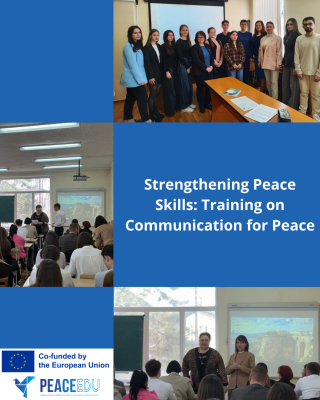
 Students and faculty members interested in peacebuilding issues were invited to participate, along with volunteers from local NGOs and activists cooperating with the Innovation Agency.
The training was delivered in an interactive format and generated strong engagement among participants. Throughout the sessions, participants actively asked questions, engaged in discussions, and analyzed real-life situations related to conflicts in educational, social, and community contexts. Special emphasis was placed on the practical application of knowledge: participants worked with case studies, simulated dialogues, and developed strategies for peaceful interaction.
The practical component included exercises aimed at developing active listening, empathy, and nonviolent communication skills. Participants worked in groups, learned how to express their views appropriately in sensitive situations, and identified constructive ways to resolve disagreements.
During the training, participants • actively asked questions and discussed current communication challenges; connected theoretical approaches with real-life situations; analyzed their own communication patterns and identified conflict-generating elements; developed and presented ideas for peace messages and mini-campaigns.
The NGO “ for Innovation and Development”, together with partner organizations including the NGO “Open Education Academy” and NGO “StelsTera”, are actively involved in the implementation of the project and continue close and systematic cooperation with universities in Tiraspol, Chișinău, and Comrat.
Within this collaboration, partners regularly discuss key themes such as peacebuilding, communication, media literacy, and youth civic engagement. Special emphasis is placed on organizing joint meetings, round tables, and practice-oriented events within the student club platform. These activities provide a space for open dialogue between students, faculty members, and NGO representatives, where real social challenges, local conflicts, and nonviolent solutions are jointly explored.
This cooperation enables the integration of academic knowledge with civil society practice, encourages youth participation in community initiatives, strengthens teamwork and intercultural dialogue skills, and supports the development of a sustainable cooperation network between universities and NGOs.
Through continuous joint activities, a sustainable student club platform is being developed, contributing to practice-oriented learning, stronger institutional partnerships, and expanded opportunities for youth engagement in socially impactful initiatives.