

 My dearest friend and colleague, who is a social worker, likes to say that she is a social worker both by profession and from the heart. I remember how deeply that phrase resonated with me. Over time, I caught myself repeating it in my own way: I am a Peace Worker by what I do – and from my heart.
For almost ten years, I have worked in peacebuilding, conflict transformation, and confidence-building initiatives. My background is quite diverse: I have worked in civil service, politics, project management, and studied political science with a strong interest in international relations. But over the years I realized that beyond positions or institutions, being a peace worker became an underlying layer of how I see the world and approach my work.
Since 2020, our organization – the Center for Peace and Civic Development (CPCD) – has become deeply engaged with peace education in Georgia, although even today many people still struggle to define what it actually means in practice. For me, peace education means using the transformative power of education not only to transfer knowledge, build careers, or contribute to economic development, but intentionally – and not merely as a side effect – to contribute to building lasting peace.
Education has always been associated with progress and opportunity. But peace education asks us to go further. It asks how education can shape the way we understand conflict, how we relate to people who are different from us, how we respond to injustice and polarization, and how societies can become more resilient rather than more divided.
At the same time, peace education is not an easy concept to implement. When my colleagues and I first started discussing it more seriously in Georgia, there was a great deal of confusion. What exactly does it mean? Where should it belong? How should it be taught? What should its goals be?
The process became both – of learning and sharing knowledge simultaneously. We were exploring global concepts while also trying to adapt them to our own reality – a society shaped by unresolved conflicts, political polarization, insecurity, and collective trauma. We worked with educators, civil society organizations, international experts, universities, policymakers, religious leaders and many others who believed this work mattered.
At the same time, our efforts often felt fragmented and uncertain. This reflected broader realities that many post-Soviet societies still face: institutions in development, weak systemic approaches, and civil societies that are active and motivated but often disconnected from long-term structural change. Yet despite the uncertainty, there was always enthusiasm. I think there is something powerful about bringing together two things nobody can deny are important for our future: peace and education.
And this is where PeaceEdu Project entered our lives.
Implemented within the framework of the Erasmus+ Capacity Building in Higher Education (CBHE) programme, PeaceEdu was not simply another project. It brought something we had been missing – a systemic perspective. Through cooperation with Ilia State University, especially its Faculty of Education, and collaboration with European university and NGO partners from countries such as Finland, Germany, Austria, Ukraine, and Moldova, we started thinking more strategically about the role of peace education in higher education.
Together, we began asking deeper questions:
- What should peace education look like at universities?
- What skills and values should students develop?
- How can academia and civil society cooperate more meaningfully?
- How can education contribute not only to professional development, but also to social responsibility, resilience, and peace?
These discussions transformed the way we approached our work.
One of the most important realizations during this journey was understanding how similar many of our concerns were across countries. Whether speaking with colleagues from Georgia, Ukraine, or Moldova, we repeatedly returned to the same themes: polarization, distrust, trauma, difficult histories, rising insecurity, and the challenge of preparing young people to navigate increasingly divided societies.
In fact, many of these discussions were already unfolding while we were developing the PeaceEdu Project itself. Russia’s full-scale invasion of Ukraine had already begun, and for many of us it was another painful reminder that peace cannot be taken for granted. Suddenly, questions about war, security, resilience, and the role of education were no longer distant or theoretical for many – they became deeply personal and immediate.
In this context, PeaceEdu became much more than a traditional academic cooperation project. It was an attempt to move peace education from fragmented initiatives into a more systemic and institutional framework. Universities, civil society organizations, researchers, educators, and students from Georgia, Ukraine, Moldova, Finland, Germany, and Austria worked together to rethink what the role of education should be in societies affected by war, polarization, trauma, and insecurity. Rather than treating peace as an abstract idea, the project focused on developing concrete educational approaches that could help students critically engage with conflict, violence, historical narratives, discrimination, resilience, and social responsibility.
Together, we worked on developing peace education concepts tailored to local and regional contexts, designing and reforming university courses, curricula and instructional resources, piloting new teaching approaches, training academic staff and educators, and creating cross-regional learning networks that connected academia and civil society more closely. At the same time, PeaceEdu also created spaces beyond formal curricula through Peace Clubs, where students – in non-formal enviroment – could engage more openly and personally with difficult topics that are often absent from traditional educational settings.
Through discussions, workshops, research activities, and joint reflections, many students began exploring different perspectives, questioning existing views, and developing greater confidence in navigating sensitive and polarized issues.
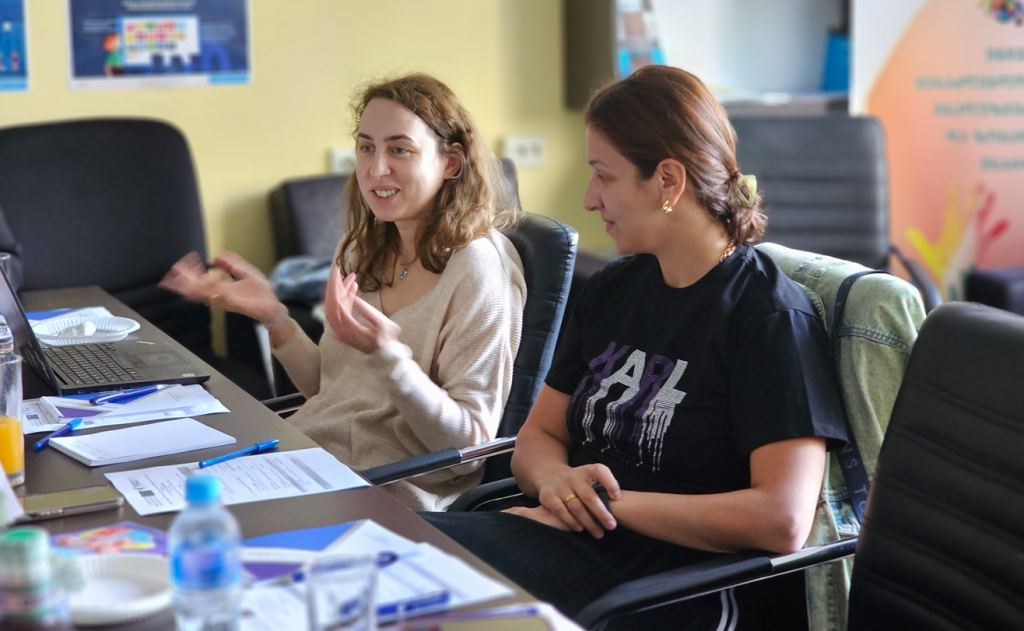
What made this process especially meaningful was that it was not based on simply transferring “ready-made” Western models. Instead, it became a space of mutual learning, where experiences from different conflict-affected and post-Soviet contexts were critically discussed, adapted, and reflected upon together. We increasingly understood that discussions around conflict, war, identity, memory, trauma, and security cannot be approached superficially. Peace education requires not only enthusiasm, but also careful methodology, conflict sensitivity, ethical reflection, and awareness of the potential harm that educational processes can unintentionally reproduce. In this sense, PeaceEdu was not only about promoting peace-related values, but also about strengthening more reflective, critical, and responsible educational practices.
As we continued implementing PeaceEdu in the following years, against the backdrop of ongoing wars, violence, and global insecurity, these discussions only became more intense. Students increasingly started asking difficult and very legitimate questions:
- Does peace work still matter in times like these?
- Can peace education really make a difference when violence continues to rise?
- Are dialogue and cooperation enough in a world shaped by war and insecurity?
And perhaps this is exactly why it became so important not to avoid these questions, but to engage with them honestly – and perhaps also, why I wanted to focus on this very issue in this blog.
In recent years, I often felt that Peacebuilding practitioners increasingly needed to re-prove why this work matters at all. When societies experience fear, instability, and geopolitical tension, peace Education can sometimes sound naïve or disconnected from reality.
But for me, peace education does not mean ignoring security threats or pretending that conflicts disappear through goodwill alone. On the contrary, it requires engaging honestly with fear, injustice, violence, and uncertainty while still insisting that human dignity, critical thinking, dialogue, and empathy matter – it is about helping people – and especially young people – navigate these realities critically and humanely, without surrendering to hatred, dehumanization, or hopelessness.
Security issues cannot be separated from peace education. The goal is not to teach simplistic ideas that “peace is easy” or that everyone simply needs to be kind to each other. Peace education is much more demanding than that – it requires difficult conversations, self-reflection, responsibility, and the courage to confront dehumanization, stereotypes, and exclusion.
Perhaps the strongest reminder that this work matters came from the students themselves.
Over the two years of working with Peace Clubs, curriculum reform processes, and educational activities within PeaceEdu, we witnessed visible transformations among many students. Many initially approached the topic with uncertainty or skepticism. Some expected Peace education to provide easy answers. Others questioned whether such work could have any impact in the context of ongoing wars and instability.
But gradually, discussions became deeper and more reflective. Students began engaging more openly with difficult histories, different perspectives, and sensitive societal issues. They questioned stereotypes, reflected critically on security and justice, and learned to navigate complexity rather than avoid it. Not every discussion led to agreement, and not every student changed their views. But many became more willing to engage with complexity, tolerate ambiguity, and listen to perspectives they would previously dismiss.
What emerged was not naïve optimism, but something much more meaningful: a deeper understanding that peace is difficult, requires effort, and cannot exist without active engagement and responsibility.
In our context, discussing peace without discussing security would feel detached from reality. Young people are growing up in societies shaped by war, occupation, polarization, and instability. “Rather than treating peace as an abstract ideal, it must also help students critically reflect on fear, security narratives, resilience, and the difficult balance between protection and humanization.
This is what makes the cooperation within PeaceEdu so important. It is not only about developing new courses or academic materials. It is about creating spaces where universities, NGOs, educators, and students learn together and from one another. It is about connecting academic knowledge with practical experience and creating systemic approaches instead of isolated efforts.
Most importantly, it is about understanding that although our contexts may differ, many of our problems – and perhaps many of our solutions – are shared.
In times of injustice, insecurity, and uncertainty, it is easy to become cynical or passive because sometimes the results are not immediately visible, and the steps you take may seem too small. But history has shown us that the alternative – silence, indifference, and disengagement – comes with far greater costs.
And perhaps this is also what being a peace worker “from the heart” means to me: accepting the difficulty and responsibility of this work while continuing to act despite doubt, frustration, or uncertainty. Enthusiasm, in this sense, is not emotional comfort or blind optimism. It is the courage to continue believing and acting – building thoughtful, ethical, and human-centered educational spaces, and through small but meaningful steps, proving that education can still help shape more peaceful futures.
Nini Kobakhidze
Center for Peace and Civic Development (CPCD)