
 During the last few years, we have often found ourselves thinking about how much the world around us has changed. Technology connects us more than ever before, yet people often seem more divided. Misinformation, social polarization, migration, and ongoing conflicts shape the way we communicate and relate to one another. In Moldova, these realities feel especially close. We live in a multilingual and multicultural society that continues to navigate the unresolved Transnistrian conflict and different narratives about identity and belonging.
In such a context, education cannot remain the same. Teachers do much more than teach subjects. Every day, through their words, attitudes, and relationships with students, they influence how young people understand diversity, respond to differences, and see the world around them. In many ways, teachers help shape the kind of society we will have tomorrow.
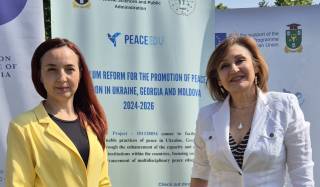
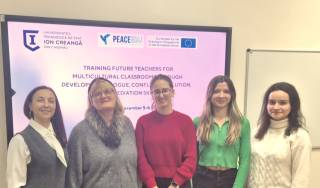
This became one of the reasons why being part of the Erasmus+ PeaceEdu project has been such a meaningful experience for me and my colleagues.
The project arrived at a particularly significant moment for our region. It encouraged us to reflect on important questions like:
- What kind of teachers does today society need?
- How should universities prepare future teachers for diverse and complex classrooms?
- Can education contribute not only to professional skills, but also to peaceful coexistence?
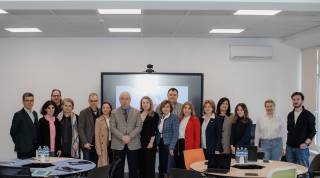
Together with colleagues from Moldova and partner institutions from Finland, Austria, Germany, Georgia, and Ukraine, we began looking at teacher education from a different perspective.
One of the most important lessons we learned was that peace education is not a separate subject that can simply be added to a timetable. Peace is a perspective that can transform how education is understood and practiced. It requires integrating values, dialogue, critical thinking, inclusion, empathy, and responsibility across educational processes.
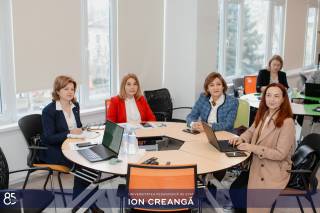
This understanding gradually found its place in our university courses. Future teachers started exploring multilingualism, intercultural communication, conflict transformation, dialogue, inclusion, and social responsibility—not as isolated topics, but as essential parts of becoming a teacher today.
For us and our students, one of the most meaningful discussions was about multilingualism.
For Moldova, multilingualism has a particularly important place in this discussion.
In our country, speaking different languages is part of everyday life. Romanian, Russian, Gagauz, Ukrainian, Bulgarian, English, and other languages are all part of our society. Before PeaceEdu, multilingualism was often discussed mainly from linguistic or political perspectives. Through this project we began to view it as a peacebuilding resource.
Multilingualism becomes not only a communicative asset, but also a bridge between communities.
Communication must become relational, ethical, intercultural, and transformative.
The project also challenged the way we think about communicative competence. Today, communicating well means much more than speaking correctly or fluently. Future teachers need to know how to listen carefully, facilitate dialogue, manage disagreements with respect, and build trust. These are the skills that help people live together in diverse societies.
The most encouraging part of this journey was witnessing how students themselves embraced these ideas. Through Peace Club, academic discussions, conferences, and university courses, they were encouraged to reflect on questions like:
- What does peace mean in contemporary Moldova?
- How can teachers contribute to social cohesion?
- How can schools become spaces where diversity is valued rather than feared?
- How can dialogue be promoted in communities affected by stereotypes, mistrust, or competing narratives?
At first, many students were unsure how to answer these questions. But over time, something changed. Their conversations became more reflective, more open, and more confident.
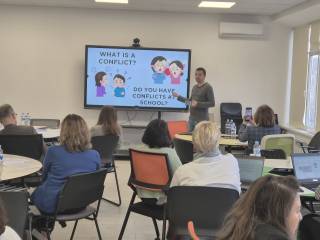
One of our favorite moments was watching future teachers design and teach simulation lessons on peace topics. What made these experiences truly meaningful was that these simulations did not remain only theoretical exercises.
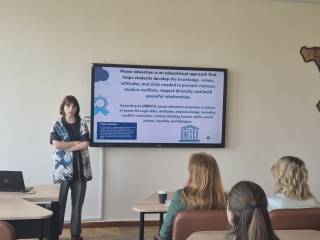
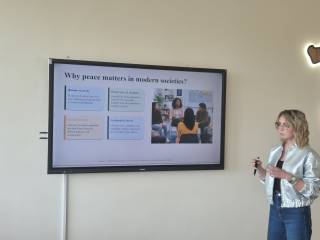
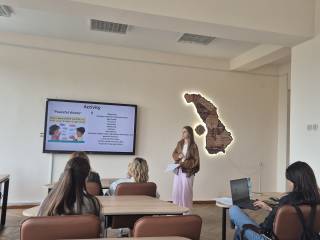
Later, during their teaching practice, students brought these lessons into public schools. They worked with pupils, encouraging them to discuss respect, diversity, peaceful communication, and understanding.
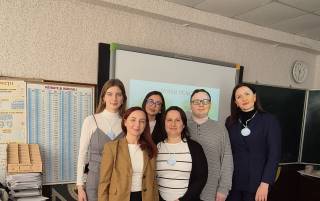
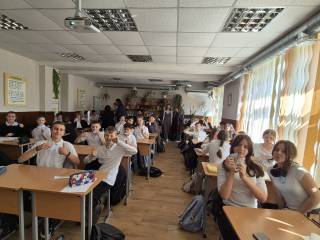
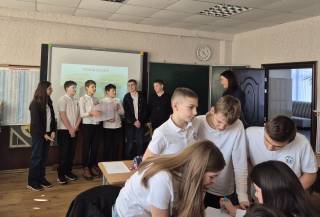 These experiences demonstrated something important: future teachers can become ambassadors of peace long before they begin their professional careers.
At the same time, we think PeaceEdu project has given us much more than curriculum changes or new teaching materials. Through different activities, the project created opportunities for us to engage with concepts that are often overlooked in educational discourse. Perhaps one of the project’s most meaningful achievements was simply creating spaces where people felt encouraged to pronounce the word “peace,” to discuss it critically and to think about what peace really means in our own society.
Thinking about Moldova, peace cannot be reduced to the absence of conflict. It means:
- dialogue across linguistic, cultural, and political differences
- schools where every learner feels respected and valued
- developing the capacity to resist manipulation, challenge stereotypes, and engage critically with information
- preparing young people for citizenship and responsible participation in society.
As teachers, we may not solve political conflicts, but every day we influence how future generations understand differences and respond to disagreement or build relationships.
This is why the work initiated through PeaceEdu project remains important!
The future of peace in Moldova will be shaped not only in political institutions, but also in schools, universities, and classrooms. And perhaps this is the most valuable lesson PeaceEdu project has offered us: peace is not something that simply exists. It is something that must be learned, practiced, and built—every day, through education, one learner and one classroom at a time.
Author: Svetlana Burea,
”Ion Creangă” State Pedagogical University, Moldova