

Project Description
Manufacturing Academy 2.0 is a project implemented jointly by Tampere University of Applied Sciences (TAMK) and SASKY education association (Sasky). It aims to promote skills and training in key manufacturing processes relevant to the manufacturing industry in Pirkanmaa area in order to both respond to the labor shortage and implementation of the goals of the green and digital transition. The project will implement a training pilot, during which a group of experts will be trained to respond to the growing and immediate labor demand of one of the manufacturing industry’s processes, grinding.
The work packages of the project are as follows:
TP1: Manufacturing Academy 2.0 positioning: The work package includes the following tasks, e.g. the contents of key Finnish projects and key educational programs of various educational institutions are benchmarked
TP2: Implementation of the training pilot: The project will implement a training pilot related to grinding. This is done using simulations (Sasky) and robotics and artificial intelligence for e.g. monitoring (TAMK).
TP3: Manufacturing Academy 2.0 concept: The Manufacturing Academy 2.0 operating model is developed in the project. Manufacturing Academy 2.0 includes, for example, the selection and working of pedagogical solutions as guidelines, supporting the needs of the manufacturing industry.
TP4: Communication and networking (TAMK): In the short term, the project primarily offers new experts to meet the demand for one of the key processes in the manufacturing industry, grinding. In addition to this, the project renews the process training of the manufacturing industry in a way that better corresponds to the digital and green transition. The long-term effects of the project (five years or more) are related to establishing the educational model developed in the project and increasing the attractiveness of the field among young people. The project contributes to the competitiveness of the machine industry by bringing digitization into practice through new, established operating models.
Grinding Training
Grinding Training Materials on DigiCampus Moodle
The grinding training learning materials developed within the Konepaja-akatemia 2.0 project will be published on the DigiCampus Moodle platform in May 2025. The course provides an introduction to different aspects of grinding processes, including tools, process parameters, cooling methods, quality assurance, and occupational safety. The materials are specifically designed for students in mechanical and production engineering as well as for competence development of industrial personnel.
and occupational safety. The materials are specifically designed for students in mechanical and production engineering as well as for competence development of industrial personnel.
ll be published on the DigiCampus Moodle platform in May 2025. The course provides an introduction to different aspects of grinding processes, including tools, process parameters, cooling methods, quality assurance,
Self-paced study
The course is intended for independent study and has no fixed start or end dates. There is no active teacher assigned to the course; however, you may submit questions or feedback to the course instructors via the DigiCampus Moodle discussion forum and feedback channel.
Logging in to DigiCampus Moodle
The course is accessible without an enrolment key. You can log in to DigiCampus Moodle in several ways:
- Haka login: using higher education institution credentials (select your organisation from the list)
- Google account: for example, using a Gmail address
- Suomi.fi authentication: using online banking credentials or a mobile certificate
- Guest user: you can create your own user account if you are not affiliated with any organisation
Access DigiCampus Moodle via THIS LINK.
VR Grinding Simulator – Learning in an Authentic Virtual Environment
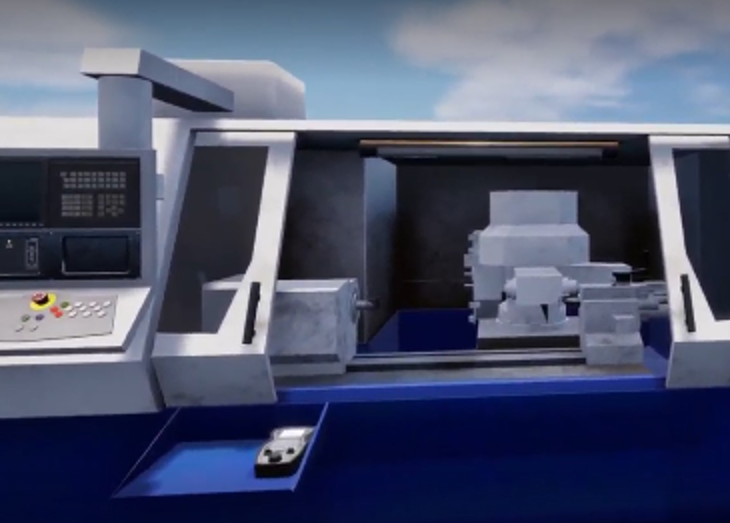
The VR grinding simulator developed in the Konepaja-akatemia 2.0 project enables students to practise different stages of the grinding process safely and visually in a virtual environment resembling a real industrial setting. In the current development version, the simulator allows operation of the basic functions of the grinding machine, workpiece positioning, adjustment of process parameters, and visual feedback.
The realistic user interface, visually enhanced operating environment, and integrated safety considerations make the simulator an effective tool for learning operational procedures. Future development will focus on features such as damage scenario simulation, expert guidance support, and extended control of grinding parameters.
Video of the VR grinding simulator: