

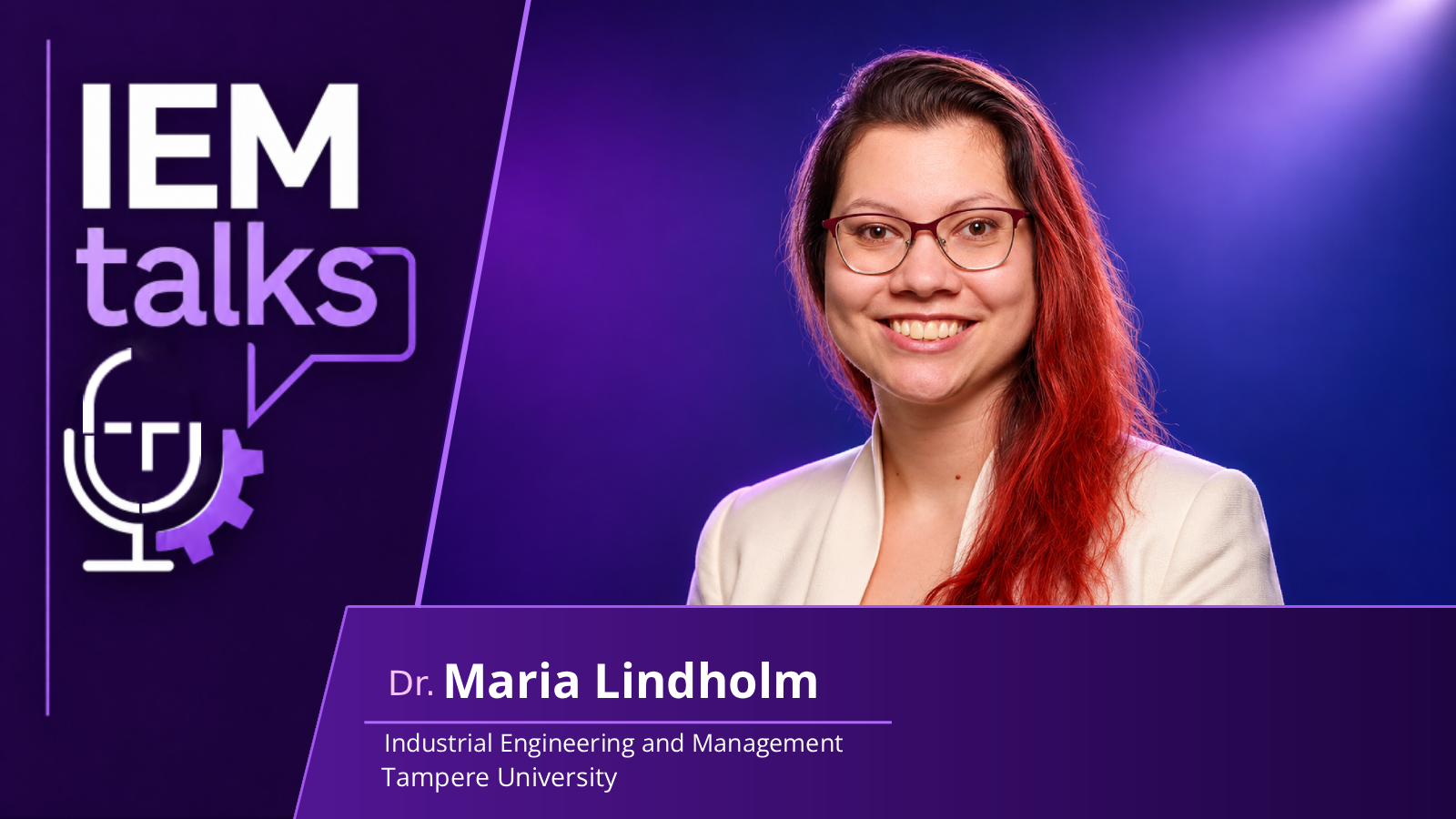
Maria Lindholm
Assistant Professor of Safety Management
Industrial Engineering and Management, Tampere University
You became an Assistant Professor of Safety Management at Tampere University in August 2026, after working as a postdoctoral researcher for several years. What is your work at the Centre for Safety Management and Engineering (CSME) like today, and what has changed in your new position?
Maria Lindholm: My current work is quite a varied combination of research, teaching, supervision, developing research activities, and applying for funding. I work as a project manager in research projects, conduct my own research, and write scientific articles. I teach a couple of courses and supervise students’ theses. I am also having discussions with potential future doctoral students.
My work also includes responsibilities within the university community. For example, I am part of the planning group for doctoral program in business and technology management, known as TOTO. Outside the university, I serve as Vice Chair of the Finnish Ergonomics Association.
Since becoming an assistant professor, perhaps the biggest change has been that my work is now more goal-oriented, with a stronger focus on the longer-term future. Previously, my work focused more on my own research and individual projects, one at a time. Now my role is gradually changing so that, alongside my own research, I am developing my own research direction and, in the future, will also supervise my own doctoral students.
You studied Industrial Engineering and Management at the University of Oulu, and during your studies, you also worked in electronics manufacturing at Nokia Solutions and Networks, including three-shift work. What did those summer jobs mean to you at the time?
Maria Lindholm: I took those summer jobs just for the money, nothing more to it!
Your master’s thesis focused on developing workplace safety meetings and encouraging employees to participate in improving occupational safety. Where did your interest in occupational safety originally come from, and how did you eventually end up pursuing a research career?
Maria Lindholm: I originally started my studies in electrical engineering. I soon realised that I wanted to work more with things related to people. That is why I chose Industrial Engineering and Management and took all the courses I could find related to well-being at work and occupational safety.
I became interested in human behaviour and pretty much everything related to occupational safety. I think it should be obvious that no one should get injured at work or have to retire early on a disability pension.
I ended up on a research career almost by accident. Toward the end of my undergraduate studies, I spent quite a lot of time thinking about whether I should go into industry to develop occupational safety, work for a public authority, or stay in the university world.
As I was finishing my master’s thesis, a professor mentioned that they were about to start a new project and that I could stay on to work in it and begin my doctoral dissertation. That settled the decision, and I am still on that path today.
I am still broadly interested in everything related to occupational safety.
In your doctoral research, you studied physical and psychosocial workload factors in different professions and working conditions, including the experiences of informal caregivers. Later, you were involved in projects such as SafeKoti, which examined the safety of health and social care workers working in clients’ homes. What have these different research experiences taught you about occupational safety?
Maria Lindholm: The research involving informal caregivers and the SafeKoti project are actually among my favourite projects. The experiences of informal caregivers were really touching and memorable.
The SafeKoti project, on the other hand, brought some welcome variety. It has been really nice to step outside the industrial sector from time to time. I feel that my perspective has broadened, and it has been useful to see how occupational safety is managed in different sectors and what similarities and differences there are between them.
You have been involved in projects such as RiskiOnni and SafeObs, which have focused on improving workplace risk assessments and the use of safety observations. How do research ideas like these usually emerge, and how do the actual needs of companies influence the planning of research projects?
Maria Lindholm: In almost all our projects, we try to take into account the needs that come from our company partners. An idea can come from our own interests, the findings of previous projects, or discussions with companies.
We then develop the topic so that it includes both scientific research and practical activities that directly benefit organisations.
I feel that this has been a really successful approach. We work with many of the same companies again and again because they have realised that they also benefit from collaborating with us.
In 2019, you spent five months on a research visit to Karolinska Institutet in Sweden. Looking back at your academic career, which encounters, decisions, or opportunities have been the most important turning points for you?
Maria Lindholm: Looking back, I can identify a few significant turning points in my career.
During my bachelor’s studies, I stayed behind after a lecture to talk with a teacher. I told them that I was interested in activities related to well-being at work and occupational safety, and I asked how I could get involved in teaching and research.
The teacher immediately took me to meet a professor, and before long I was working as an hourly paid teaching and research assistant. Through this opportunity, I was able to complete both my bachelor’s and master’s theses as part of research projects.
I had dreamed of studying abroad since high school. During my doctoral studies, that dream finally came true when my supervisors and I started discussing international opportunities and possible places for a research visit.
I was considering the Nordic countries and Germany. I ended up choosing Sweden because my supervisors had contacts at Karolinska Institutet. I think the discussions definitely moved forward more quickly because I could immediately tell the Swedish professor that my supervisors had recommended contacting him.
Another important moment in my career came toward the end of my doctoral studies. My supervisor forwarded a message from Sari Tappura saying that they needed a project researcher in Tampere to temporarily replace one of the researchers at CSME.
I sent an email with fairly modest expectations. I introduced myself, attached some articles and reports I had written, and mentioned that I would be happy to continue the discussion if they were interested.
It did not take long before we were already discussing how much I would be able to work. After completing my doctorate, I moved to CSME as a full-time employee.
The most recent significant event was, of course, being selected as an assistant professor. Before that, I had applied for a few other positions that had opened up in Industrial Engineering and Management, but I had not been selected.
I feel that practising the application and interview process did me a lot of good and helped me succeed in the most important application of all, when I applied for the Assistant Professor position in Safety Management.
You have come a long way from being a doctoral researcher to a postdoctoral researcher and now an assistant professor. An academic career certainly includes both successes and more difficult periods. What experiences have stayed with you the most, and what has helped you keep going during challenging times?
Maria Lindholm: I already listed some of the turning points in my career, but in general, almost every project includes both successes and quieter periods.
Sometimes it can feel as though nothing is moving forward and that your own research does not really matter. Then you have another moment when something suddenly clicks, and by the end of the project, you can look back and think, we really did get a lot done!
It would be miserable to work alone. A good team and project colleagues help you get through the difficult times!
Throughout your career, you have collaborated extensively with researchers from different fields, companies, and other working-life organisations. How important do you consider this kind of collaboration, especially when research aims to solve practical problems in working life?
Maria Lindholm: Collaboration with working-life partners is essential. Without it, we certainly would not have achieved such good results.
In your recent research, you have examined topics such as safety observations, employee participation, companies’ digital capabilities, and changes brought about by technology, workforce diversity, and the green transition. In your opinion, what are the most important challenges for the future of safety management, and how can Industrial Engineering and Management help address them?
Maria Lindholm: In my own research, I have indeed looked at safety from quite different perspectives, such as safety observations and employee participation, companies’ digital capabilities, and the new occupational safety challenges brought about by technological development, increasing workforce diversity, and the green transition.
One thing that connects these themes is that work and working environments are changing rapidly, and safety management needs to be able to identify risks that we do not yet understand very well.
On the other hand, working life has always been changing, and some of the same themes are appearing now as they did decades ago. This is one interesting perspective: what is actually new, and what is something old that is simply appearing in a different context?
Also, new technology is often used alongside older technology, which can lead to unexpected situations.
Research on digital capabilities has shown, for example, that adopting technology is not simply a technical issue. An organisation’s skills, management, working practices, and opportunities for employees to participate all influence how the introduction of technology works in practice.
I think Industrial Engineering and Management has a major role to play. Safety does not develop separately from the rest of an organisation’s activities. It is shaped by decisions about technology, processes, skills, management, and how work is organised.
That is why I think Industrial Engineering and Management can help shift the focus from managing individual risks to considering how we build organisations that are capable of identifying, anticipating, and managing the risks brought about by changes in working life.
Finally, you have gained experience in industry, research, teaching, and international collaboration. What advice would you give to Industrial Engineering and Management students and young researchers who are still finding their direction and considering different career opportunities?
Maria Lindholm: Be open to all opportunities. You never know where they might lead in the long run.