Information about events can also be found on the GPT-Lab events and news page: https://gpt-lab.eu/latest-news/
Up coming event
———————————————————————————————————-


Official information channel for GENT project (1.5.2024-31.1.2027)

This section contains events organized by the GENT project, as well as news related to the project’s media presence and project themes.
Information about events can also be found on the GPT-Lab events and news page: https://gpt-lab.eu/latest-news/
Up coming event
———————————————————————————————————-
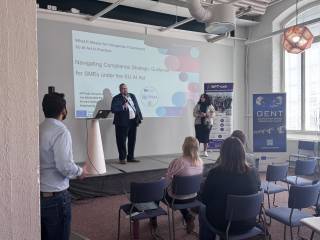 As part of the GENT – Generative AI in Business Development project, GPT-Lab at Tampere University organized an event in UCPori to support companies in understanding the EU AI Act and its practical implications for business.
A key contribution presented at the event was GPT-Lab’s work on EU AI Act guidance for SMEs, which resulted in the book Navigating Compliance: Strategic Guidance for SMEs under the EU AI Act. The book translates complex regulatory requirements into structured and practical guidance for SMEs, covering areas such as AI risk classification, organizational roles, transparency requirements, and compliance actions.
Building on the research and guidance developed for the book, GPT-Lab developed TESSA, an AI assistant designed to help companies apply the EU AI Act in practice without requiring extensive legal expertise. TESSA provides interactive and situation-specific guidance, allowing companies to ask questions about their AI systems and better understand relevant regulatory requirements and recommended actions.
Key Highlights from the Event
1) Practical EU AI Act Guidance for SMEs. The event introduced companies to the key requirements of the EU AI Act and discussed what these requirements mean in practical business contexts. The book Navigating Compliance was presented as a research-based and practical resource for helping SMEs approach AI Act compliance systematically.
2) From Research to Practice with TESSA.
Participants were introduced to TESSA, developed based on the research and guidance provided in the book. The demonstration showed how the book’s structured knowledge can be made more accessible through an interactive AI assistant, providing situation-specific support for areas such as risk classification, roles, transparency, and compliance actions.
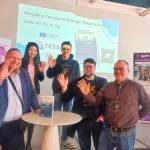
3) Engagement with Companies and Identification of Potential Pilot Cases. The event created an opportunity to engage with companies and organizations in the Satakunta region and discuss their AI-related needs, regulatory challenges, and practical experiences. Participants were also introduced to opportunities to participate in future GENT pilot activities and were invited to express their interest in bringing potential company use cases for further exploration.
Together, the book and TESSA form a practical EU AI Act support toolkit for SMEs: the book provides the research-based foundation and structured guidance, while TESSA provides an interactive way to access and apply this knowledge. The event contributed to the GENT project’s objective of strengthening responsible, practical, and regulation-aware AI adoption among companies in the Satakunta region.
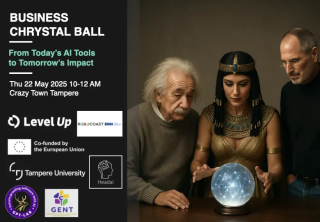
The latest Business Crystal Ball event brought businesses from across Satakunta together to explore how today’s AI tools are shaping tomorrow’s impact. Hosted at Crazy
Town Pori and organized by GPT-Lab (Tampere University) under the GENT – Generative AI in Business Development project, the session offered practical guidance for companies looking to integrate generative AI into their development processes.
Key Highlights from the Event
1) Responsible and Sustainable AI Skills. The Pori edition featured contributions from Kai-Kristian Kemell (GPT-Lab) and Harri Ketamo (Headai). They provided perspectives on responsible AI use, sustainable skill development, and real business cases that demonstrate how AI can be implemented impactfully. Their insights helped increase awareness of what effective AI use looks like — and where companies can aim next.
2) Making Generative AI Practical and Safe for Business. Muhammad Waseem presented how the GENT project is helping companies in the Satakunta region adopt generative AI safely and effectively. His talk highlighted practical use cases, tools, and methods — including the “Sandbox” environment — that enable organizations to turn generative AI potential into measurable operational value.
 3) Understanding the EU AI Act and Tools for SME Readiness. Chalisa Veesommai Sillberg delivered an insightful talk on the EU’s AI Act, focusing on what small and medium-sized enterprises should prepare for when placing AI systems on the EU market. The session included a demonstration of the EU AI Act Tool, showing how SMEs can assess their systems, understand their obligations, and plan their compliance steps early and efficiently.
Throughout the event, participants had opportunities to exchange experiences, discuss challenges, and explore new ways to leverage AI in regional development. The strong engagement underscored the growing momentum around responsible, effective adoption of generative AI within local businesses.
The GPT-Lab at Tampere University, together with its project GENT (Generative AI in Business Development), organized the Business Chrystal Ball event to explore how today’s AI tools are shaping the future of business and society.
The event took place on Thursday, May 22, 2025, from 10:00 to 12:00 at Crazy Town Tampere. It brought together companies and organizations from different sectors to discuss how artificial intelligence is transforming industries, and what actions were needed to remain competitive in a rapidly evolving environment.
Three leading experts from GPT-Lab, which also leads the GENT project, took the stage:
They shared insights into how AI was being applied across industries and provided foresight on the opportunities and challenges that lie ahead.
The Business Chrystal Ball formed part of GENT’s mission to strengthen AI capabilities in the Satakunta region and beyond, by providing companies with knowledge, pilots, and foresight into the adoption of generative AI.
Participation was free of charge and open to all industries, as AI has applications across nearly every field.
The event was organized in cooperation with the EU-funded Level Up and GENT projects, with support from RoboCoast EDIH, Headai, and the European Union.
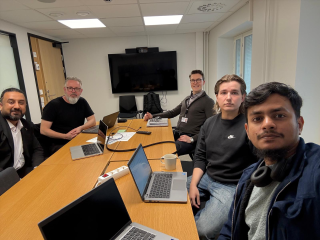 GPT Lab officially launched its collaboration with Pori City Unemployment Services as part of the GENT project. The kickoff meeting brought together the project team and city representatives to align on goals, expectations, and the roadmap for the initiative.The project’s primary aim is to explore how AI-driven automation can support and transform unemployment services. A central focus is on automating routine inquiries and case handling, which will help reduce the workload of service staff, speed up responses to citizens, and free up human resources for more complex and value-adding tasks.By addressing these routine but critical processes, the project seeks to make unemployment services more efficient, accessible, and user-friendly, while also serving as a model for responsible AI adoption in the public sector. This marks an important step in demonstrating how generative AI can contribute to practical, real-world improvements in municipal services.
As part of the GENT – Generative Artificial Intelligence in Business Support project, GPT-Lab at Tampere University prepared a regional report examining the current state of artificial intelligence and generative AI in Satakunta. The report (Artificial Intelligence for SMEs-based Software Engineering in Satakunta region) maps the regional AI landscape, compares developments with Finnish and international trends, and identifies opportunities for strengthening AI adoption among SMEs.
The report places particular emphasis on industry–academia collaboration as a mechanism for helping SMEs access AI expertise, technologies, research capabilities, and skilled talent. It also reviews practical business applications of generative AI and large language models, ranging from customer service and marketing to process automation, knowledge management, predictive maintenance, and decision support.
Key Highlights
1) Mapping the AI and Generative AI Landscape in Satakunta.
The report provides a baseline overview of AI adoption in the region and identifies existing research, education, business, and innovation activities. It highlights regional strengths such as AI-related research centers, educational programmes, collaborative initiatives, and companies already applying AI, while also identifying gaps related to investment, startup development, and international collaboration.
2) Practical AI Opportunities for SMEs.
The report identifies a broad range of AI and generative AI applications that can support SME growth, including customer-service automation, personalized marketing, content generation, business reporting, supply-chain optimization, predictive maintenance, recruitment, knowledge management, and decision support. It also outlines how large language models can help SMEs improve productivity, customer experience, and internal business processes.
3) Industry–Academia Collaboration and AI Strategy.
A major focus is how collaboration between companies and academic institutions can reduce barriers to AI adoption. The report discusses mechanisms such as joint research projects, technology transfer, internships, professional development, and knowledge-transfer activities. It also proposes a structured AI-strategy process covering business objectives, data and infrastructure, technology selection, skills, governance, regulatory compliance, and continuous monitoring.
4) Responsible and Regulation-Aware AI Adoption.
The report connects AI adoption with responsible software engineering and the EU AI Act, emphasizing risk assessment, compliance-by-design, data governance, transparency, human oversight, robustness, and monitoring. This provides an early foundation for helping regional SMEs consider regulatory requirements alongside technical AI development.
Overall, the report provides the GENT project with a regional baseline and strategic foundation for future company collaboration and pilot activities. It identifies where generative AI can create business value, what barriers SMEs may face, and how industry–academia collaboration can support practical, responsible, and regulation-aware AI adoption in Satakunta.