

11.2.2026
The Political Nature of Art and Its Relationship to Funding Structures
This blog post is based on contributions presented in the Art and Politics webinar, which addressed the ethical, political, and structural dimensions of contemporary art. The webinar was given in Finnish, but its recording is subtitled in English. The speakers, Jaana Erkkilä-Hill and Rita Paqvalén, approached the topic from complementary perspectives, highlighting how questions of artistic freedom, responsibility, power, and norms are inseparable from broader societal and political contexts. The discussion is also connected to the KUVATA project, which seeks to explore and develop new income models for artists amid significant reductions in public funding for art and culture.
Jaana Erkkilä-Hill focused on the ethical foundations of artistic practice, particularly in relation to artistic research and participatory forms of art. She emphasized that artistic work never takes place in a vacuum: artworks inevitably involve other people, communities, and more-than-human actors, whether intentionally or unintentionally. From this perspective, artistic freedom must always be considered alongside responsibility. The publication of the Ethical Guidelines for Arts and Culture Sector in Finland reflects a growing recognition of the need to safeguard both artists’ freedom of expression and the rights of those who become part of artistic processes as subjects, materials, or participants.
Erkkilä-Hill paid special attention to autoethnographic and autofictional methods, which often draw on the artist’s personal history. While these approaches can be powerful tools for reflection and critique, they also raise ethical questions related to consent, privacy, power, and fundamental rights. Even when artists work with their own experiences, they inevitably create representations of others whose perspectives and vulnerabilities may not be equally visible or protected.
Erkkilä-Hill’s contribution was grounded in dialogical ethics. A central principle is the recognition of the other’s humanity and the artist’s responsibility to reflect on their own position of power. Ethical artistic practice requires attentiveness to social, cultural, and structural inequalities and a refusal to exploit vulnerability. Importantly, Erkkilä-Hill also emphasized that participatory or community-based art does not always need to be overtly politically activating; even brief, aesthetic encounters can be ethically meaningful without producing measurable social change.
Rita Paqvalén approached the political nature of art from the perspective of power, norms, and institutional structures within the art world. She challenged the notion of art as a neutral or autonomous sphere and questioned whose artistic freedom is actually being protected. According to Paqvalén, the art field is always shaped by norms that define what is considered high quality, universal, or legitimate art. These norms are closely tied to power and privilege, shaping which voices are heard, whose work is valued, and whose experiences are dismissed as overly political, personal, or marginal.
Paqvalén highlighted how gender, background, language, and minority status affect artists’ access to recognition, funding, and institutional support. The art world operates through gatekeepers, networks, educational structures, and funding mechanisms that are not equally accessible to all. As a result, artistic freedom is not a universal condition but one that is unevenly distributed and shaped by visible and invisible norms. Paqvalén argued that as long as some lived realities are labeled political while others are treated as neutral, the promise of equal artistic freedom remains unfulfilled.
Both speakers emphasized that art is inherently political: not in the sense of party politics, but as a form of social practice that engages with values, norms, power relations, and democracy. Art can create spaces for disagreement, critical reflection, and dialogue, contributing to democratic culture by making tensions and conflicts visible rather than suppressing them. At the same time, the speakers warned against instrumentalizing art as a mere tool for predefined political goals. The value of art lies in its capacity to open thought, foster imagination, and challenge assumptions.
These reflections are particularly relevant in the current funding context. Public funding for art and culture in Finland has become increasingly scarce, with significant cuts implemented by the current government. While some municipalities are able to compensate for national cuts, others are forced to reduce cultural budgets further, deepening regional inequalities and limiting artists’ opportunities to work professionally. Reduced funding also affects the accessibility of art and cultural participation.
The KUVATA project explores the possibility of diversifying artists’ income sources. While partnerships with civil society organizations, educational institutions, social and health services, and local communities may offer new opportunities, they also raise ethical questions about values, autonomy, and power. Political or ideologically driven funding, in particular, can threaten artistic independence and create pressure to align content with specific agendas.
While developing new income models is necessary, it must not come at the expense of artistic freedom, ethical responsibility, or democratic values. Stable public funding remains essential, especially for critical, experimental, and minority art forms that are unlikely to attract market-based support. Ultimately, discussions about art funding are not only economic but deeply ethical and political: they reflect choices about the kind of society we want to build and the role we believe art should play within it.
References:
KUVATA webinaari #8: Taiteen poliittisuus – Jaana Erkkilä-Hill ja Rita Paqvalén: https://www.youtube.com/watch?v=V7Wz2ooPwDQ
Ethical Guidelines for Arts and Culture Sector: https://eettinentaide.fi/en/
Information about the Speakers, the Article’s Author, and the KUVATA Project
Webinar speaker Jaana Erkkilä-Hill, DA, is a visual artist, researcher, and Professor of Fine Arts at the University of Lapland. Her work focuses particularly on ethical questions in artistic research and artistic practices that involve diverse communities, including both human and more-than-human participants.
Webinar speaker Rita Paqvalén, PhD, is the Executive Director of Culture for All Service and a non-fiction writer working in the fields of art and culture. Her book Queera minnen. Om tystnad, längtan och motstånd was published in 2021.
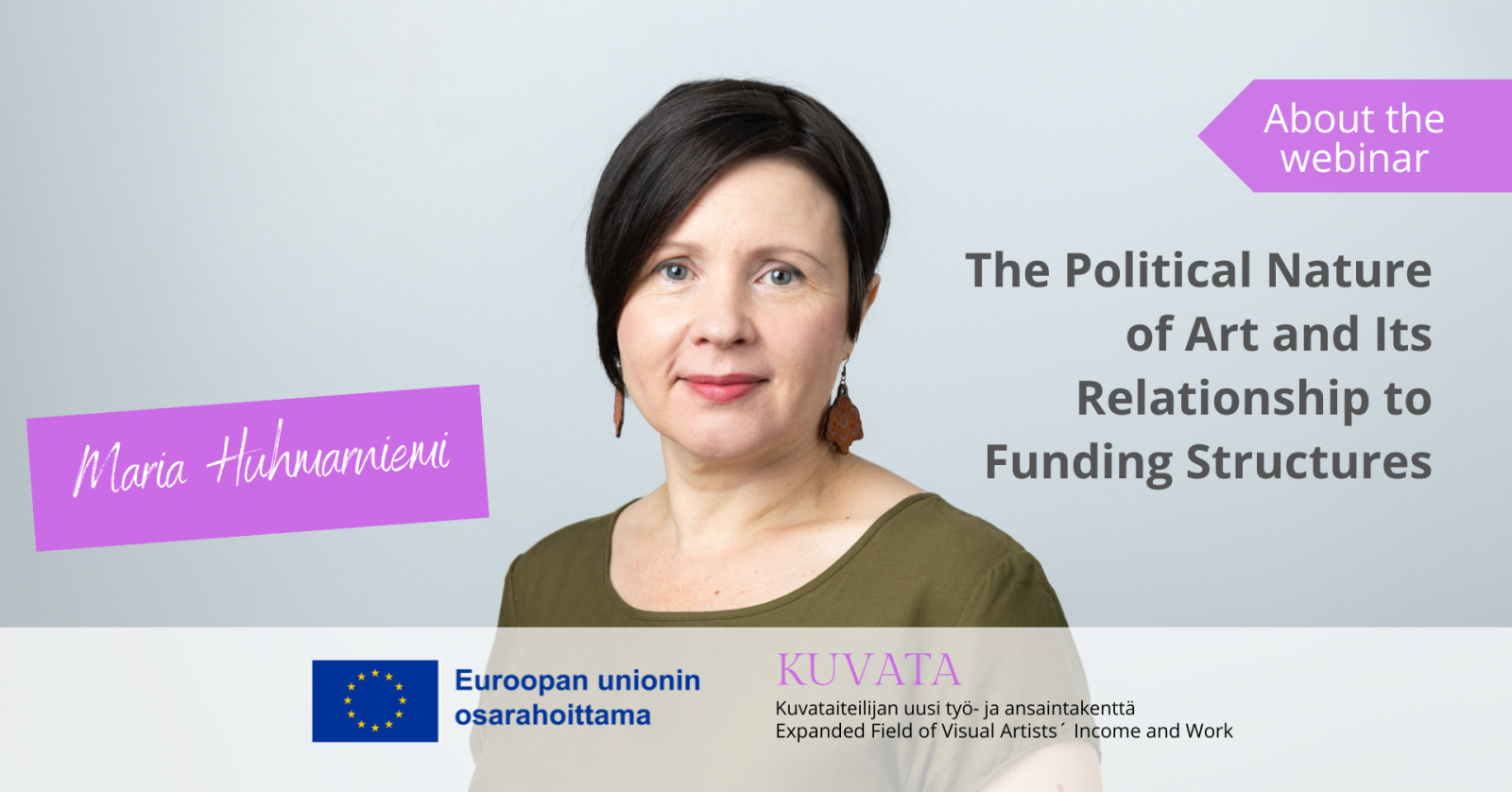
Article author Maria Huhmarniemi, DA, is Vice Dean responsible for the development of teaching and Associate Professor of Art Education at the Faculty of Art and Design, University of Lapland.
KUVATA: New Fields of Work and Income for Visual Artists is a project that supports the professional practice and livelihoods of Finnish visual artists by providing training, webinars, and practical tools for today’s art field. The target groups include professional visual artists and educational institutions across Finland. The KUVATA project (2024–2026) is coordinated by Tampere University of Applied Sciences in cooperation with the University of Lapland and Globe Art Point Association. The project is funded by the EU’s ESF+ programme via the Häme Centre for Economic Development, Transport and the Environment (ELY Centre).