

And that makes the construction and real estate sector an important part of the equation.
Through AI Champion, we are working towards an ambitious goal: developing 100 AI agents for the construction and real estate industry, with a particular focus on improving automation and information flow across building services and construction supply chains.
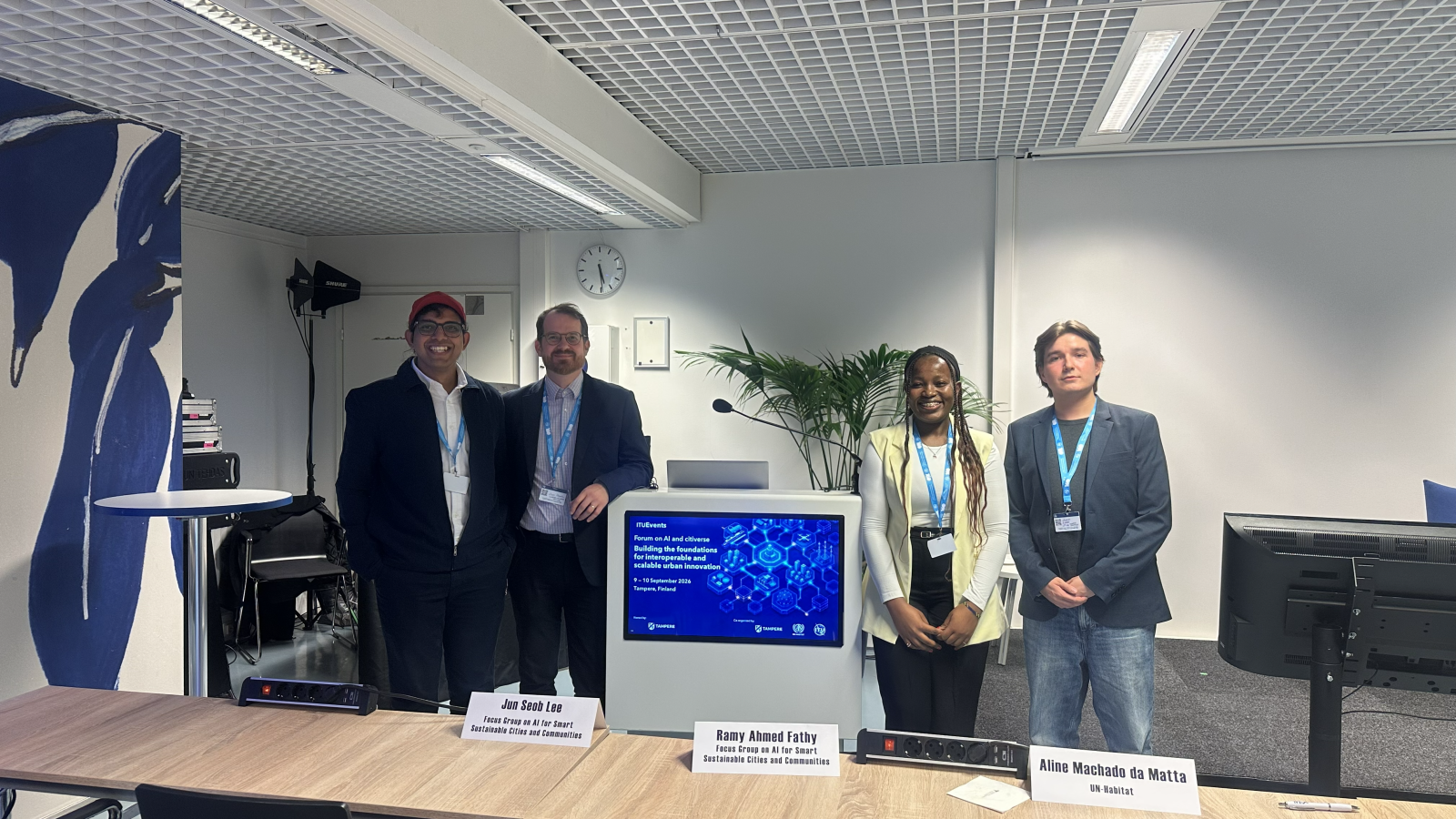
Last week, Jussi Rasku, Millenium Anthony and Rajratan Wankhade brought some of this work into the international conversation at the Forum on AI and the Citiverse in Tampere, organized by the International Telecommunication Union (ITU) and UN-Habitat, together with the City of Tampere.
One question connected the different examples we brought to the forum: How can AI move beyond generating information and begin helping us make better decisions?
Jussi introduced the work being carried out through GPT-Lab and AI Champion, including how AI could support route planning and optimization in logistics.
Millenium presented “Democratizing Optimization for Smarter Cities,” using a warehouse optimization case to explore how multi-agent systems and generative AI could help generate, test and improve heuristics for complex planning and optimization problems. The same approach can be applied to several different use cases across architecture, engineering and construction, where planning, sequencing, logistics and resource allocation are constant challenges.
Rajratan presented “An Agentic AI Factory That Learns to Optimize: HVAC Control for Energy Savings,” featuring an HVAC use case developed in collaboration with Koja and exploring how agentic approaches can support optimization in building systems.
Warehouse optimization with multi-agents and HVAC control may seem like very different problems. But underneath them is a shared challenge: how do we enable complex systems to use data to plan, optimize and adapt more intelligently?
And that question matters directly to construction.
The future of cities is built one building, one renovation and one retrofit at a time.
For the construction and real estate sector, that means smarter planning, more efficient logistics, better use of building data, more adaptive building systems, and stronger connections between design, construction, operation and maintenance.
Smart cities will require more than increasingly powerful AI models. They will require automation, optimization and reliable information flows across the built environment, from construction sites and supply chains to HVAC systems, building operations and long-term asset management.
That is where the work of AI Champion becomes especially relevant.
The 100 AI agentsbeing developed through the project are not simply about reaching a number.
They are about building and testing capabilities that could help the construction and real estate industry plan better, reduce inefficiencies, optimize building performance, automate repetitive processes and support better decisions across the lifecycle of a building.
Because if the cities of tomorrow are going to become smarter, the buildings, construction processes and infrastructure behind them will need to become smarter too. 🌍
And the AI agents we are experimenting with today could become part of the intelligence behind how those buildings are designed, built, renovated and operated tomorrow.
In the Business Finland funded AI Champion Co-Innovation project, we aim to find out the design and construction challenges in Building Services and create a 100 AI Agents to solve these challenges and enhance the supply chains. Co-operators and funders in AI Champion are Tampere University, University of Oulu, Granlund, Fira, Koja Chiller, KONE Oyj, ETS NORD, Kiilto, GF BFS, Nimlas, LVI-INFO, Sähköteknisen Kaupan Liitto ry and Airlyse.