

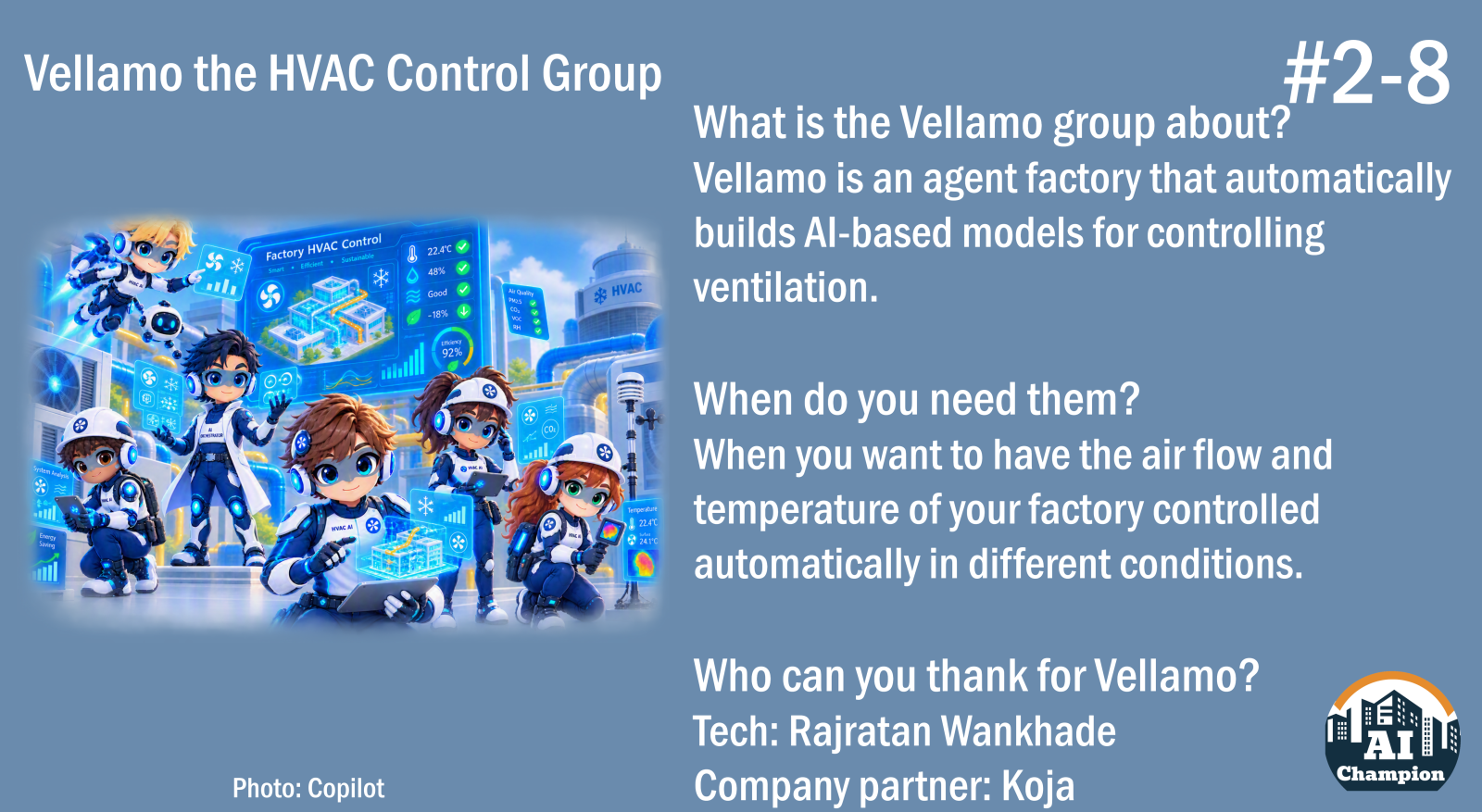
What does Vellamo do?
Vellamo is a multi-agent system that automates the end-to-end development of machine learning-based ventilation control. Using measurement data from a building and its air handling unit, it builds and trains a control model capable of adjusting the ventilation system to reduce energy consumption while maintaining good indoor air conditions. The resulting machine learning model can adapt to changing conditions and determine the best course of action for each situation.
Vellamo combines AI agents based on large language models, predefined checks, and machine learning models. The agents interpret the user’s objective expressed in natural language, plan and manage the work, determine the required steps, and respond if a step fails or the result does not meet the specified requirements. Predefined checks process and validate the data and evaluate model quality. This adds a deterministic layer to the development workflow alongside the AI agents.
Ultimately, Vellamo produces two machine learning models for ventilation control: a prediction model that learns how the building and its air handling unit behave, and a reinforcement learning model that learns how to control the system using this digital twin. The result is an optimized ventilation control strategy.
How does Vellamo work?
In short: Define the objective and provide the building data. The agents then build a prediction model of the building, use it to train a control model, and evaluate the results. Indoor air conditions remain good, energy consumption is reduced, and no machine learning expertise is required.
Step by step:
- Provide the objective in natural language, for example: “Create a ventilation optimization model that minimizes energy consumption while maintaining high-quality indoor air conditions.”
- The agents build a model of the building. They check the quality of the data and create a prediction model that describes how indoor air conditions respond to changes in ventilation settings.
- The control model is trained using the prediction model. The reinforcement learning model tests a vast number of different control actions under different conditions and learns how to maintain good indoor air conditions while minimizing energy consumption.
- The results are evaluated and, if necessary, the training process is run again. The evaluation is carried out using predefined metrics.
This makes it possible to deploy ventilation optimization without manually building and training a separate model for every individual air handling unit. Because the entire development pipeline is automated, the same approach can be repeated for other air handling units and buildings. Only data from the new target building is needed, while the process itself remains the same, controlled, and traceable. In the future, the Vellamo agent factory can also be expanded to other use cases.
Read more about how Vellamo was developed for Koja-Chiller during the AI Champion researcher exchange.
Read more about the origins of the Vellamo concept in Alina Suvanto’s story on the Koja Group website.