

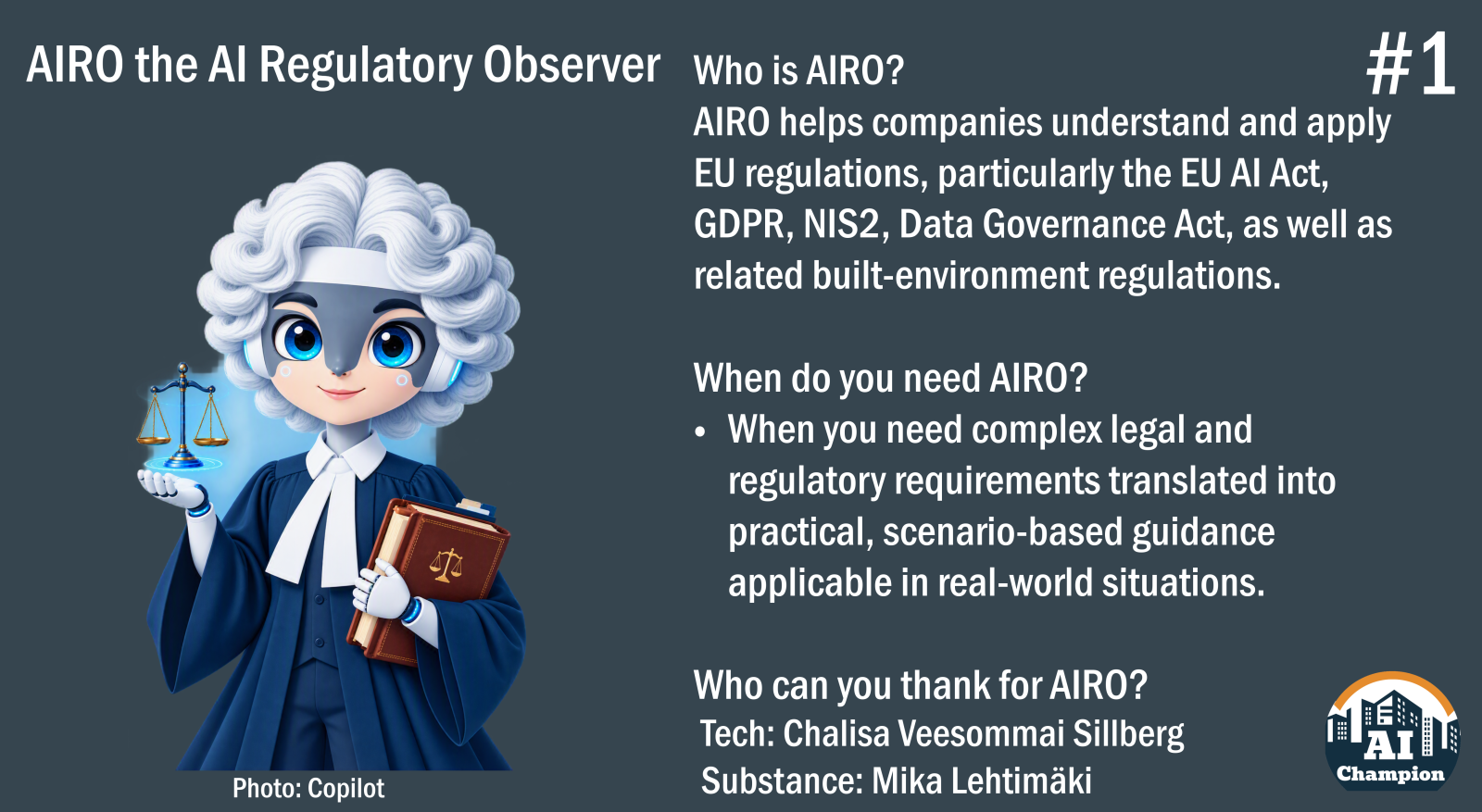
Who is AIRO?
AIRO is a practical AI-powered assistant that helps companies understand and apply EU regulations, particularly the EU AI Act, GDPR, NIS2, Data Act, Data Governance Act, Cyber Resilience Act, and EU Taxonomy Regulation, as well as related built-environment regulations.
The AI assistant AIRO helps you to understand how to use AI responsibly by providing guidance on AI governance, data protection, human oversight, cybersecurity, data sharing, and regulatory compliance.
How can AIRO help companies?
It translates complex legal and regulatory requirements into practical, scenario-based guidance that companies can apply in real-world situations.
When do you need AIRO?
- Use it when you need to understand which EU regulations apply to your activities and what they mean in practice.
- When planning to use AI in your workflow.
- When planning to introduce AI into your workflow it is important to consider what the AI can do, which regulatory requirements may apply, and what responsibilities your organization may have. AIRO can guide you through this process step by step, from defining your AI use case to identifying applicable regulations, responsibilities, and practical compliance measures.
- Define your AI use case – Describe the AI system, its purpose, expected outputs, and where it will be used in your business or workflow.
- Identify applicable EU regulations – Check which regulations may apply, such as the EU AI Act, GDPR, NIS2, Data Act, Data Governance Act, EU Taxonomy Regulation, and relevant sector-specific rules.
- Assess key obligations and requirements – Identify applicable requirements, such as AI risk classification, data protection, transparency, human oversight, cybersecurity, data sharing, governance, and documentation.
- Evaluate risks and impacts – Consider potential impacts on individuals, personal data, systems and infrastructure, business operations, compliance, and reputation.
- Define measures and responsibilities – Determine the technical and organizational measures, policies, procedures, and responsible roles needed to meet the applicable requirements.
- Plan, document, and monitor – Prepare the implementation plan and required documentation, then continuously monitor regulatory requirements and update your practices when necessary.
- When you want to use AI responsibly.