
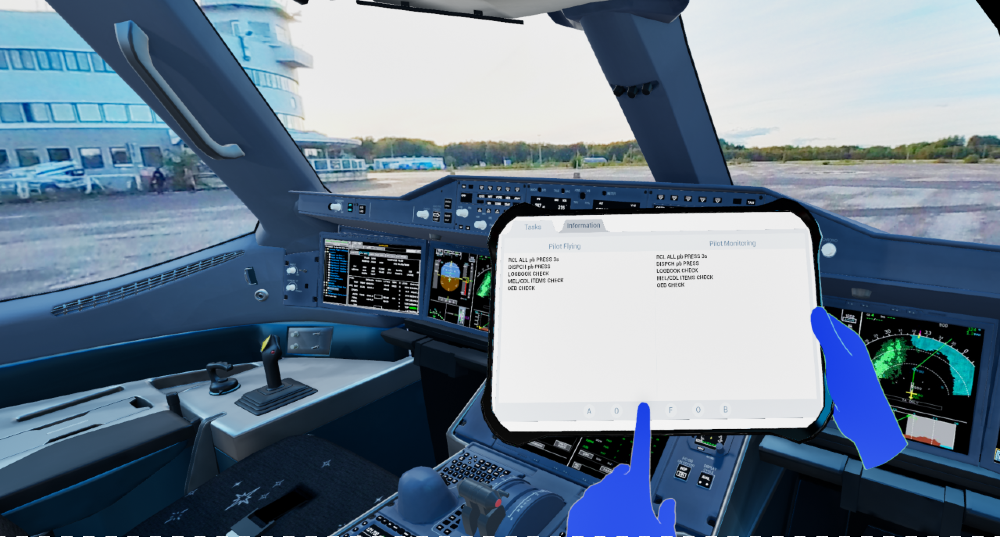
The thesis examines a VR training simulator developed within Helsinki XR Center designed for pilot training at Finnair. The technical implementation of the project utilizes the Unreal Engine 5 ecosystem and Meta Quest 3 virtual reality headsets.
The thesis evaluates the suitability of VR technology for educational applications, with a focus on hand-tracking technology and interactive learning modules. Central to the development process are the Blueprint visual scripting system within the Unreal Engine 5 environment as well as strategies for maximizing the performance and capabilities of the Quest 3 hardware.
Methodologically, the work adopts an iterative development model, where simulator components were assessed and refined through software testing phases incorporating qualitative user observations and quantitative performance metrics. Special emphasis is placed on ensuring seamless user experience and the effective delivery of pedagogical content.
Findings
The results demonstrate that Unreal Engine 5’s visual programming tools are highly effective for developing VR training simulators, particularly for rapid prototyping. However, the hand-tracking functionality of the Meta Quest 3 was found to require significant optimization in complex industrial simulations. The development process underscored the importance of balancing technical constraints with educational efficacy, highlighting the challenges of resource management in VR-based training solutions.
Find out more about the Finnair case from a former news article on the XR-SPACE project website.
Text by Katariina Saarela, photo by Helsinki XR Center.