

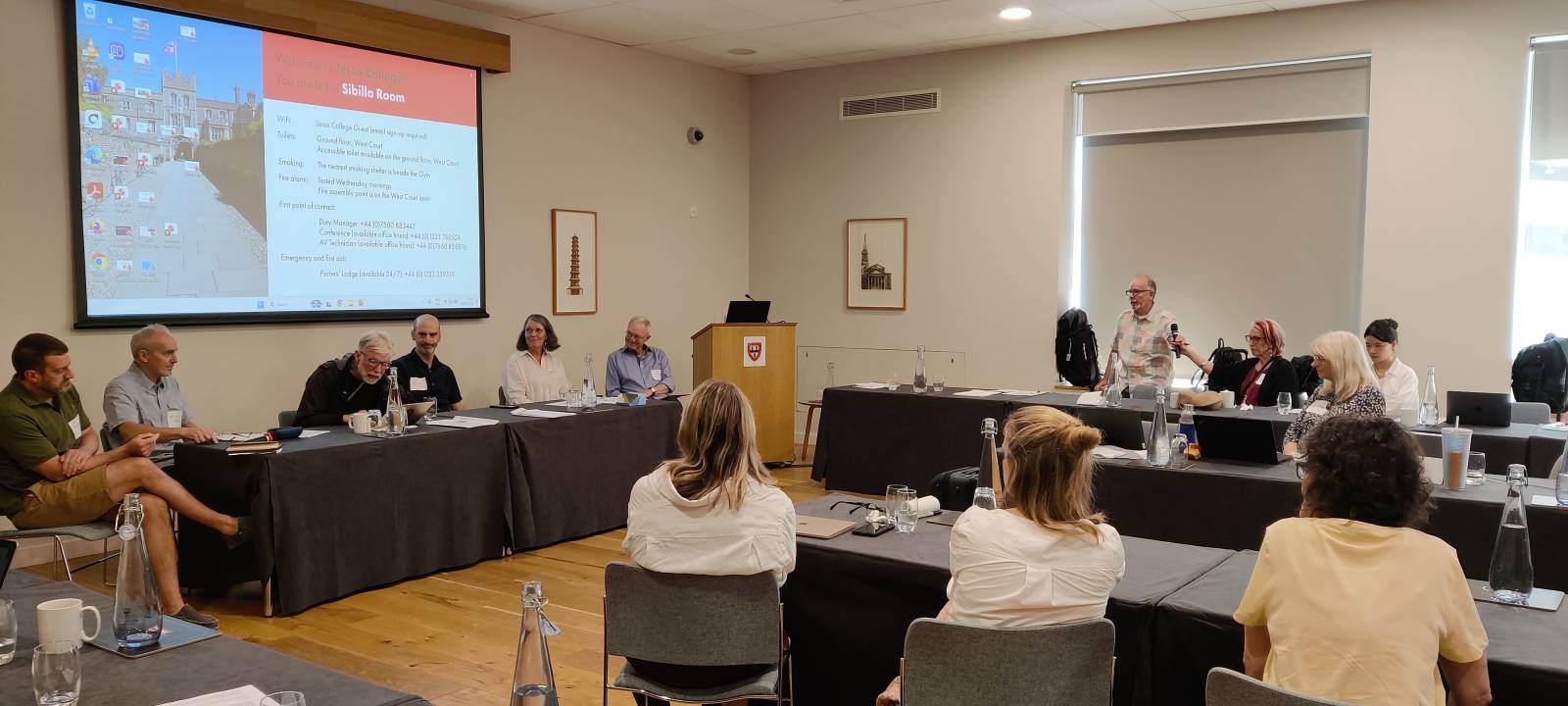
In the middle of hot summer in the UK, the 8th symposium ‘Knowledge in Education’ was held at the Jesus College at the University of Cambridge on 7-8 July 2026. The symposium has its roots in the earlier Bernstein symposia, and later social realism symposia, and still today, Basil Bernstein’s concepts were mentioned and elaborated in almost all of the papers presented, as was the importance of knowledge in and for education at different levels.
Around 40 people from five continents joined one shared session for two days, including key scholars in the field, professor emerita Leesa Wheelahan and professor emeritus John Muller, but also emerging researchers in the field, including doctoral students. Cambridge University provided a highly inspirational environment for sharing.
A paper (that is currently under review) by our project members – Urakova, Madureira Ferreira, Holubek and Annala – was presented by Johanna Annala to this community of scholars and discussed both formally and informally in-between the sessions. The paper is about educational knowledge through our three different disciplinary lenses – one Bernsteinian, one from a cultural historian, and one from a cognitive science perspective. It was situated in a session entitled ‘…epistemic boundaries.’ Bernsteinian researchers in the symposium found our broad framework very interesting and useful, and many are looking forward to our paper to be published.
Finnish scholars with expertise in research on knowledge were acknowledged and appreciated, and new networks were created. A symposium of this kind, with a small community of people specialized with certain theoretical-methodological approaches and with very light administration and organization, was a wonderful experience.
The same paper was later presented in greater detail by all four authors at the ECER conference in Tampere in August, as part of a research panel in the Higher Education Research Network (Network 22). The ECER conference had around 3800 participants from educational sciences!
Different audiences and communities contribute in different ways to our thinking, either deepening or broadening, but still advancing the project idea: how to bring more attention to the question of knowledge in higher education, especially to students’ relationships with knowledge.
Johanna Annala