
Background
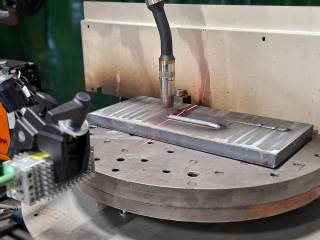
The Smart Manufacturing and Intelligent manufacturing concepts and technologies are combining advanced design, predictability, and control tools for rapid reconfigurability of key manufacturing technologies. For example, robot enabled welding, robot enabled additive manufacturing such as wire arc additive manufacturing (WAAM) and direct energy deposition (DED) can be enhanced by intelligent and efficient offline preparation and the use of intelligent control. Those manufacturing processes share commonalities as they are highly dependent on automation and robotization. They can all be based on arm robots and as such they can be seen as a common process based on arm robotics but varying via the change of the tool or via the usage of the tools. Those arm-based processes are flexible but come at the cost of lower accuracy when compared with other machine architectures such as cartesian machine architectures.
Aim & Objectives
The project has two main objectives:
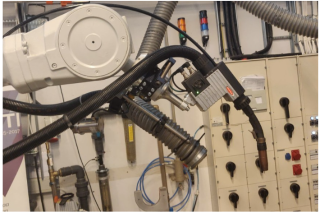
- Development of a robotic welding control box capable of dynamically adjusting welding parameters in real time using sensor feedback, such as welding cameras, pyrometers, and line scanners. This control system is intended to improve weld quality and robustness by reacting instantly to process variations.
- Creating an offline modeling and simulation framework that captures the thermal and mechanical behavior induced by welding. This framework relies on Finite Element modelling and a multidisciplinary adaptive optimization approach to determine optimal welding sequences and parameters, with the aim of minimizing distortions and thermally induced stresses in manufactured components.
Implementation
The development of the box will be carried out through three complementary industrial use cases covering two manufacturing processes, welding and welding based additive manufacturing. These cases cover different manufacturing scales and batch sizes, ranging from one-lot size production to medium batch sizes. The control box aims to enable a manufacturing unit with short ramp-up times, increased productivity, and quality. The work content of the ROBOT BOX project resonates with four of the six SMART technical domains and demonstrates the benefits and added value of global technology, business collaboration and value chains in realizing such a complex and comprehensive manufacturing control framework and its components.