

Artificial intelligence is increasingly reshaping how work is organized, how teams collaborate, and how workers develop professional identities. Yet the dominant focus of AI research remains on knowledge-intensive, screen-based occupations — and on improving individual productivity rather than collective work. CAI-BLUE investigates a largely overlooked domain: the integration of AI agents into blue-collar, team-based environments such as manufacturing, maintenance, and logistics.
These settings present a fundamentally different context for AI design. Blue-collar work is physically grounded, socially embedded, and dependent on tacit expertise — knowledge built through years of hands-on experience, encoded in gesture and judgment rather than documentation. Work unfolds through continuous coordination between people, through shared attention and collective problem-solving that cannot simply be optimized away. Introducing an AI agent into such a setting means introducing a new participant into an existing social and organizational fabric, with consequences that extend well beyond task efficiency.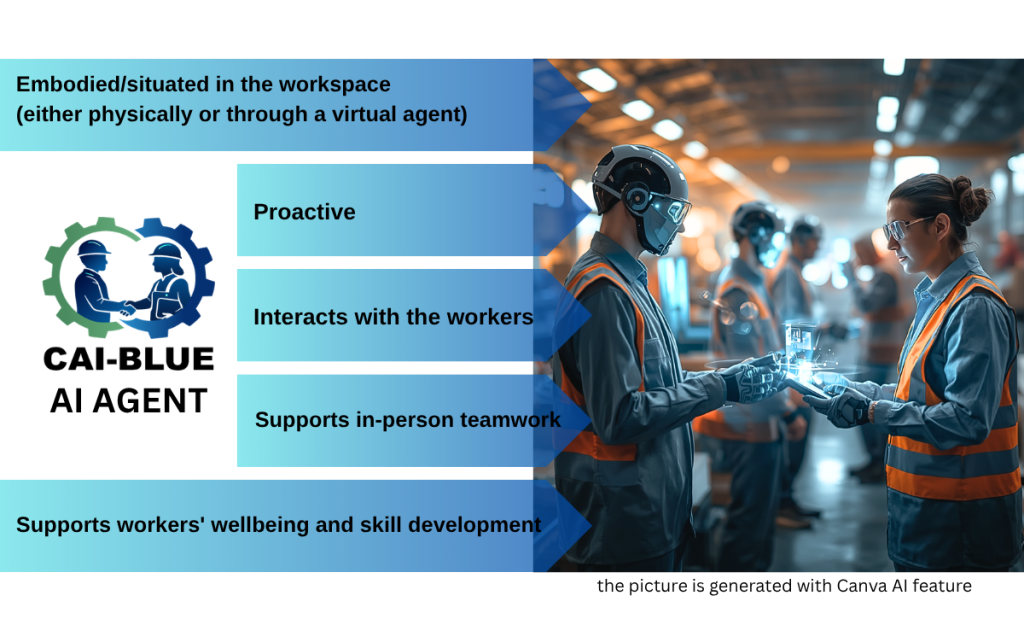
CAI-BLUE approaches this challenge from a clear position: AI agents should function as complementary collaborators, not substitutes for human labor. The goal is systems that support and enhance workers’ capabilities while preserving their expertise, agency, and professional identity. This requires careful attention to how AI is introduced — and to the ethical dimensions of that process. Grounded in the Nordic model of work life, the project is guided by values of well-being, participation, and inclusion. Technological progress is only meaningful here if it strengthens collaborative work rather than disrupting it.
The research gap and objectives of the study
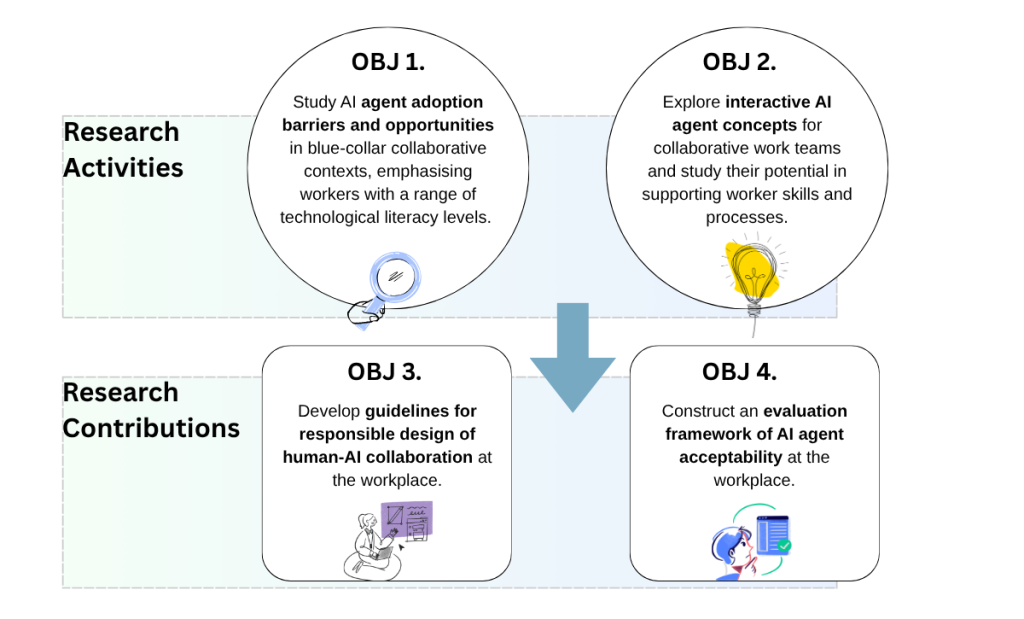
Despite growing interest in human-AI collaboration, there is a significant deficit of empirical and design research focused on blue-collar contexts. The risks of poorly conceived AI integration here are concrete: increased surveillance, erosion of worker autonomy, and the devaluation of skills that are often difficult to articulate but critical in practice. CAI-BLUE addresses this gap directly, grounded in the Nordic model of work life and its emphasis on workers’ well-being, participation, and inclusion. To address this gap, CAI-BLUE pursues the following research objectives:
Approach and contributions
The project combines ethnographic field studies, participatory design, and iterative prototyping — conducted in close collaboration with workers and organizations. This methodology ensures that design decisions are informed by how work actually unfolds, not by idealized assumptions about it.
CAI-BLUE produces three interconnected bodies of knowledge: empirical accounts of how blue-collar workers perceive and engage with AI in collaborative settings; design frameworks and prototypes for responsible, inclusive AI agent development; and evaluation criteria that assess AI systems against worker experience — specifically autonomy, competence, and social acceptance.
Expected impact:
- Increased understanding of AI agents and their adoption in blue-collar work
- Support for worker skills and wellbeing
- Enhanced trust and inclusion
- Tools for responsible AI deployment
The project’s broader aim is to advance a model of technological integration that strengthens rather than disrupts collaborative work, and that extends the benefits of AI innovation beyond the occupational groups currently at its center.