
Aim
Aim
What the project is about?
The project explores parental incarceration from different perspectives focusing on children and parenthood, and on developing research-based social services for the families in the shadow of prison.
The project addresses the following main research question:
How are the children’s relations with their incarcerated parents, and the needs of the children seen from different perspectives as institutional views and as lived experiences?
Background
Despite a growing body of research pointing to the complex problems children of incarcerated parents may face, we still know too little about parental incarceration and how to best support these vulnerable children and families.
Work packages
- Institutional views
- Children
- Supportive parenting intervention
- Education
Impact
By researching the perspectives concerning children who experience parental incarceration, we are able to develop:
- Conceptual understandings of these relationships, and
- Research-based services for children and their parents according to their needs, and consequently make then institutionally visible in social services.
Research environment
Funding
The project is funded by the Ministry of Social Affairs and Health (Finland).
Partners
The project is conducted in Tampere University in collaboration with the Wellbeing Services County of Pirkanmaa (PIRHA) and the NGO, Life without crime (RETS).
We commit to the Philosophy of Slow Science
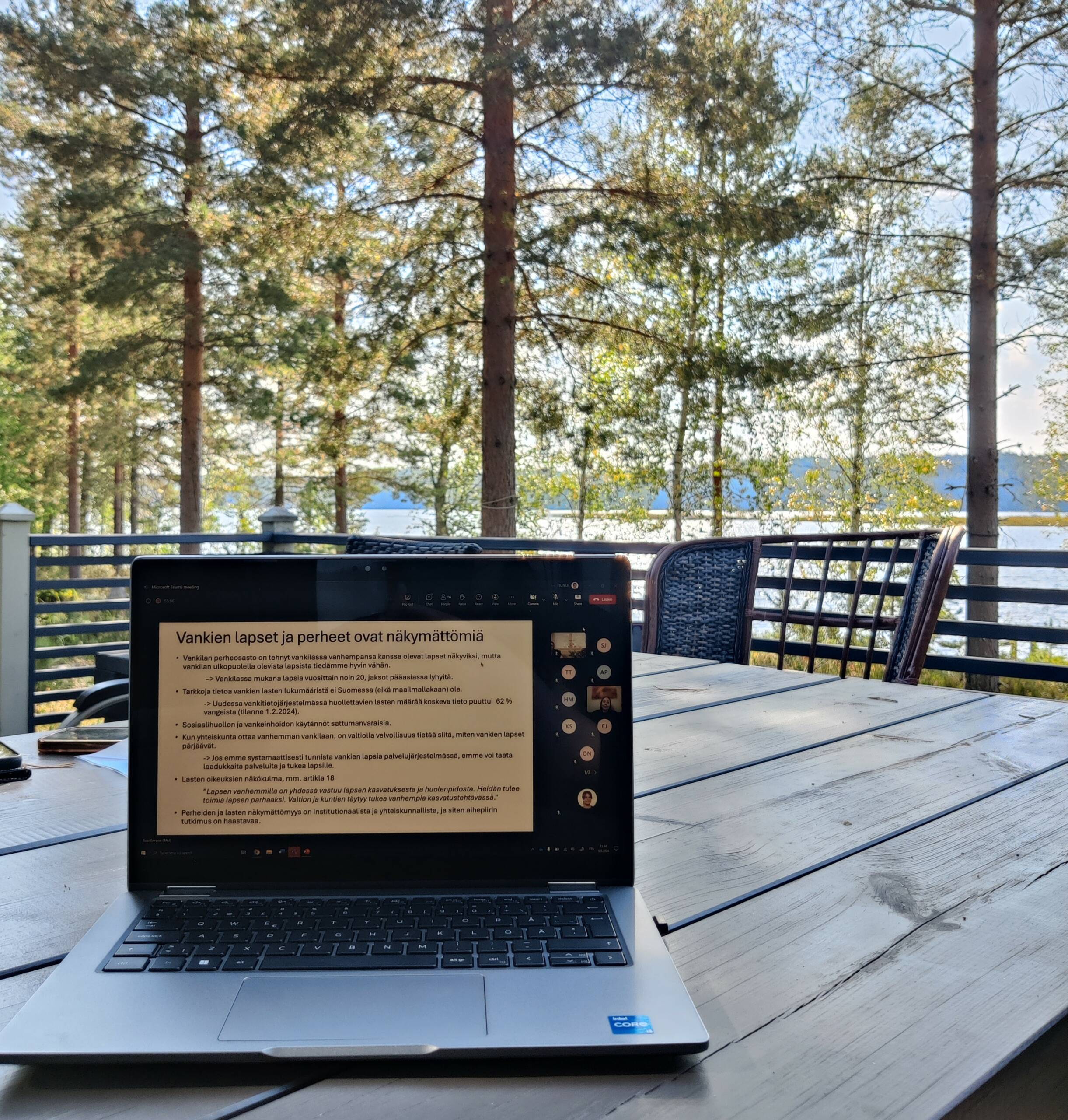
We are committed to the philosophy of Slow Science – a research approach and movement that challenges the accelerating pace of academic work and the pressure for rapid results and publications. Slow Science emphasizes the importance of allowing time for deep thinking, thorough investigation, creativity, and critical dialogue.
This approach does not advocate slowness for its own sake but rather recognizes that meaningful research requires time. We are dedicated to conducting research with care, acknowledging the complexity of the phenomena we study.
The core principles guiding our commitment to Slow Science include:
- Research takes time.
- High-quality science demands deep engagement and the ability to tolerate uncertainty.
- Collaboration, interaction, and reflection are essential working methods.
- In publishing, quality must take precedence over quantity.
- The well-being of researchers and a calm working environment are vital resources for generating new knowledge.
In line with these principles, we believe that science should be conducted in a human-centered, responsible, and thoughtful manner. Within our project, we continuously develop practices that support this philosophy. For example, we aim to begin meetings no earlier than 10:00 a.m., reserving mornings for focused, independent work or tasks that require deep concentration. We also regularly reserve days for collaborative writing.