
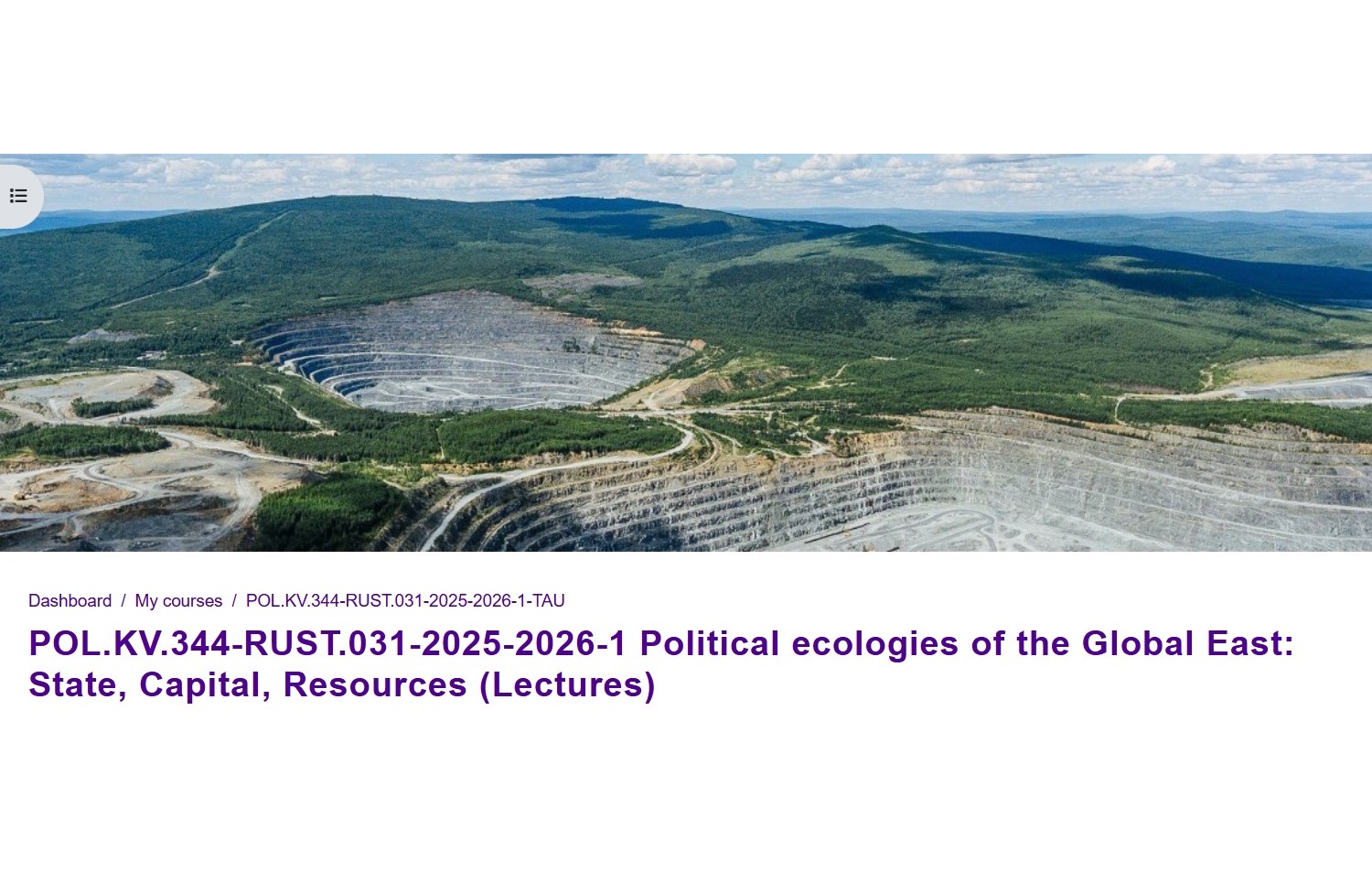
This course investigates the intricate political, economic, and ecological developments in the Global East: the postsocialist spaces which have undergone political and economic transition. The course begins with an introductory lecture that provides an overview of political ecology as an academic field, highlighting current debates and tracing its emergence from critical political economy. This lecture sets the stage for the course by bridging theoretical and empirical perspectives, offering a comprehensive understanding of how political ecology examines the intersections of international political economy and ecological changes.
Throughout the course, students will explore various theoretical and political debates within political ecology, engaging with topics such as extractivism, social ecological movements, indigenous politics and resistance, authoritarian state power, and transnational neoliberal development policies. Empirical case studies from Armenia, Ukraine, Russian Sápmi, Uzbekistan, and Russia will be used to illustrate these concepts.
2.09 12-14 Iuliia Gataulina, Tampere University: Introductory lecture – “What is Political Ecology?”
9.09 12-14 Elena Holmgren, University of Helsinki: “Fighting Colonial Legacies and Environmental Injustices in Modern-day Russia.”
16.09 12-14 Anni Kangas, Tampere University: “Authoritarianism and Political Risk in Critical Raw Material Resource Imaginaries of Central Asia.”
23.09 12-14 Mirkka Ollila, University of Helsinki: “Indigenous Arctic Russia: Environmental Governance, Extractivism, and Indigenous Cultural Environment.”
30.09 12-14 Madina Gazieva, Dublin City University: “The Green Hegemony. Making Sense of Contemporary Articulations of Society-Environment Relations in Central Asia.”
7.10 12-14 Alexandra Barmina, University of Helsinki: “Contested Dynamics Behind Extractive Frontier-Making in Armenia.”
7.10 14-16 Yuliya Yurchenko, University of Greenwich: Concluding lecture. Lecture title and content TBC.