
The Co-production of Humans and Livestock in Finnish Agricultural Modernization, c. 1880s–1960s
Livestock industry is a key contributor to climate change and other environmental, ethical and health problems. However, its growth is often presented as a spontaneous process out of malnutrition, which obscures meat lobbying and political measures to promote it.
Historical research has so far focused mostly on the pioneers of livestock industry (USA, UK, France, Germany), which easily leads to a straightforward and teleological story of agromodernization. While animal history has favoured pets, horses and wild animals, ‘humble critters’ such as pigs have rarely been looked at in and for themselves, despite their global prevalence and high cognitive skills.
Goal
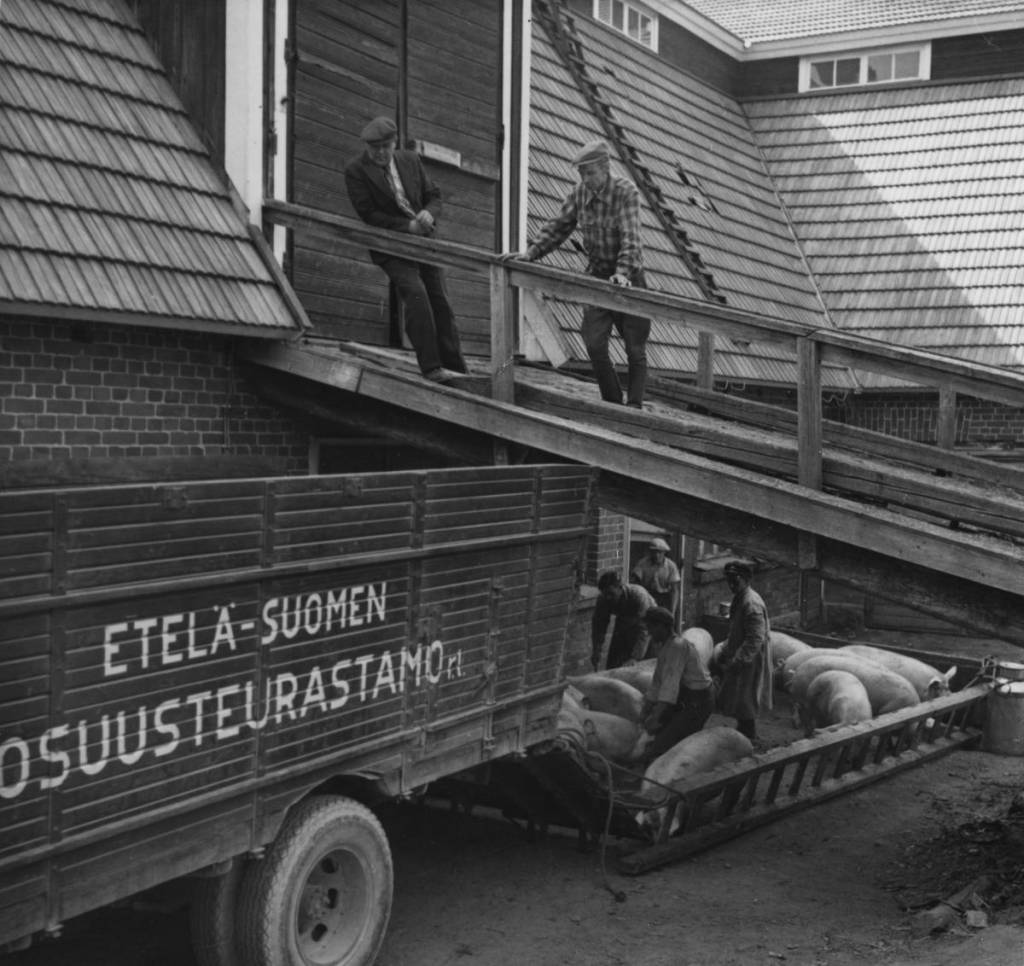
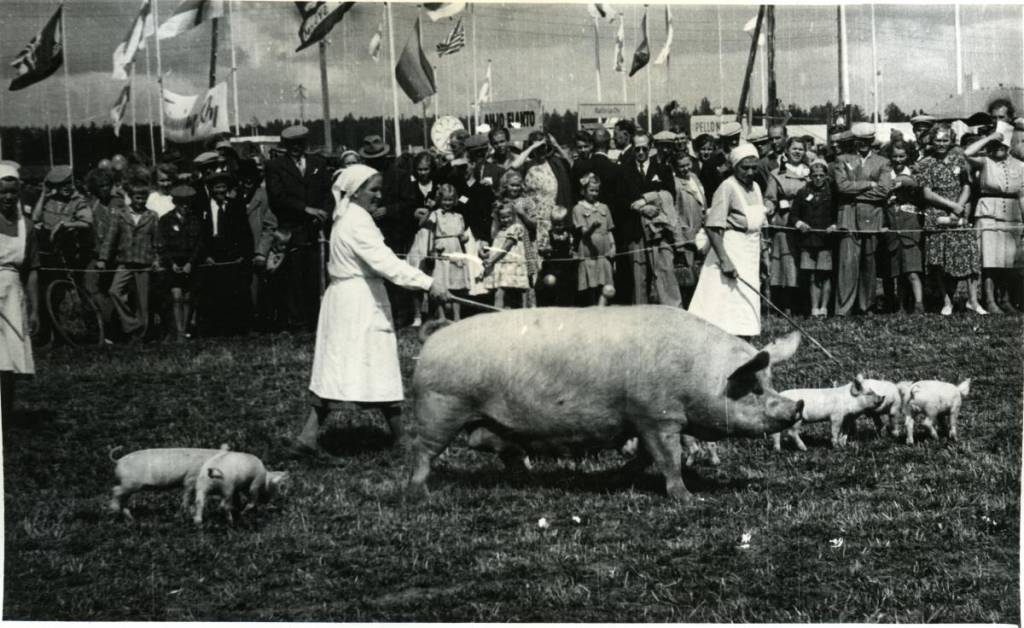
Our project examines the expansion of livestock production, the ‘meatification’ of society and the changing animal-human relationships as Finnish animal husbandry shifted from domestic self-sufficiency to commercial agribusiness, c. 1880s–1960s. Particular attention is paid to pigs, the first farmed animals produced for the meat trade in Finland.
Our research is guided by the concept of the ‘meat complex’, i.e., the changing and complex set of networks and relationships between animal agriculture, the political economy of meat and knowledge production. Data includes textual sources, supplemented by statistics, photos, drawings, floor plans of piggeries and slaughterhouses, oral histories and films. Our methodology is mainly qualitative, based on contextual and interpretative content analysis of the sources. By combining new materialism with the study of practices, we aim to investigate the relationship between structures, spaces, practices and the animal-human experiences thereof.
Drawing on interdisciplinary Human-Animal Studies and history-from-below, we read sources anew to extract an animal perspective from them. The focus is thus on relationality and the social co-production of humans and pigs.
Impact
Our project is basic research on the subject in Finland. It renews international research by showing how the values of industrial capitalism, such as efficiency, productivity and profitability, could make a breakthrough in a short period of time under conditions of proliferating small family farms. In the history of experiences, our project aims to highlight the experiences of farmed animals, and not just humans, by focusing on the multispecies relationships in which subjects are constituted and experience is produced through mutual co-shaping.
By combining cutting-edge research on the history of human and animal experiences with the latest scientific understanding of pigs’ senses, abilities and social life, the project promotes renewal of historical research by including pigs into history as agents of modernization, while also providing insights into animal welfare and behaviour research by historicising pigs’ experiences.
Funding and co-operation
The project is funded by the Research Council Of Finland, 2025–2029 (grant no. 369144).
As part of the project, the researchers will be visiting various institutions, such as Human-animal studies (University of Kassel), Swedish University of Agricultural Sciences, Aarhus Centre for Environmental Humanities, and University of Southern Denmark.