
The Need for a Circular Fashion Industry
The textile industry is sadly known for its significant negative impacts on the environment and society. The sector is estimated to generate around 10% of global carbon emissions, while also contributing to water pollution through chemical use. The large majority of textiles produced is ultimately landfilled or incinerated (Ellen MacArthur Foundation, 2024). In parallel, some estimate that there would currently be enough clothes on the planet for the next six generations, highlighting the overproduction and consumption associated with the textile industry (Community Foundation Wakefield District, n.d.).
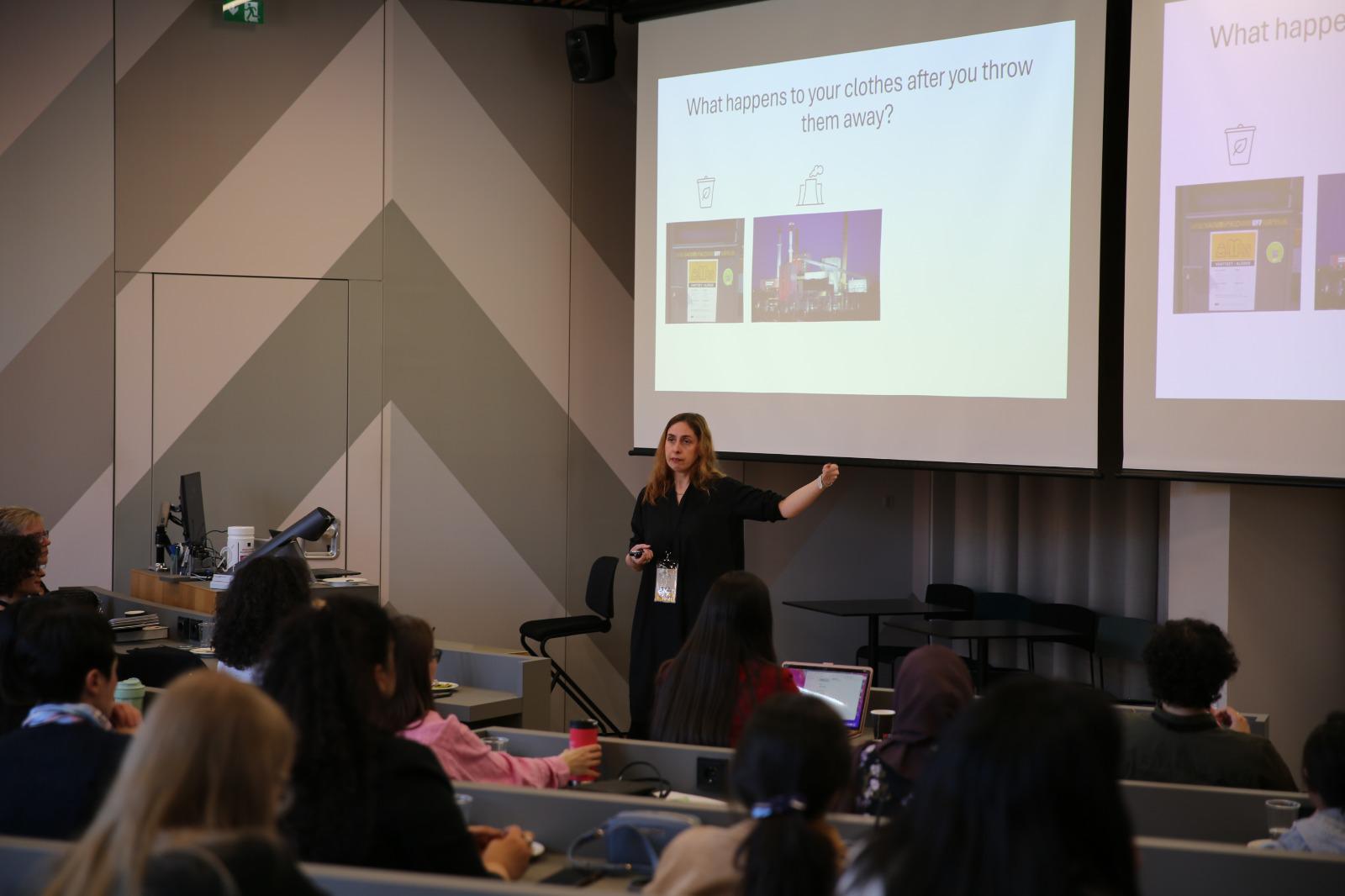
In the introductory event “Circular Economy Beyond Recycling”[i] held at Aalto University on May 7th and co‑organised by Yasmine Bounouara Parizet – Doctoral Researcher at Tampere University – experts from academia and industry gathered to introduce key circular economy concepts to an engaged audience. As one of the invited experts, Dr. Olga Dziubaniuk – Postdoctoral Researcher at Tampere University – presented a range of circular strategies and illustrated their sustainability potential through examples from the textile sector.
“The Biggest Impact Comes Before Recycling”
The textile industry and society often place heavy emphasis on recycling strategies. However, relying only on recycling to improve sustainability of the textile sector is unreliable due to three main reasons highlighted by Dziubaniuk. First, the blended composition of most textiles creates technical limits related to existing technologies and the amount of manual work needed to sort the clothes. Second, recycled fibers become downcycled and while those fibers can still be used for industrial purposes like insulation material, they cannot be reused for high-quality garments. Third, the volume of production and discarded textiles exceeds by far the current recycling capacity and demand for recycled fibers.
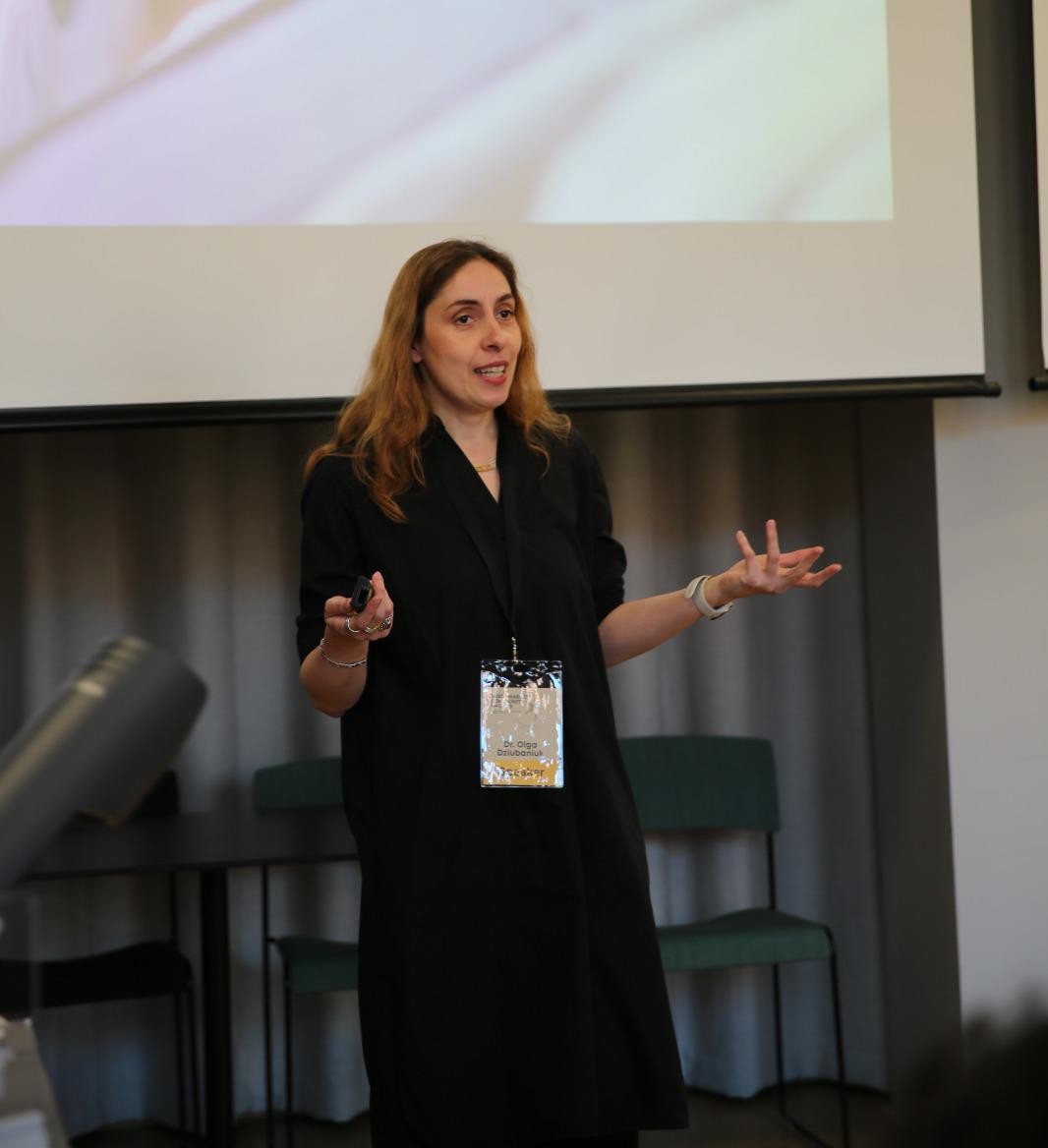
Overall, focusing solely on recycling partly ignores upstream problems related to over production and over consumption. As Dziubaniuk put it: “by focusing on recycling alone, we’re treating the symptom but not the system”. In fact, the largest environmental impacts occur long before a garment reaches the end of its life, and other circular strategies can offer greater potential for systemic change. Dziubaniuk highlighted reducing consumption as one of the most effective practice to improve sustainability in the textile sector. Furthermore, she highlighted the potential of reuse and repair models such as second‑hand markets, rental services, and consumer‑to‑consumer exchanges, in keeping clothes in circulation. Despite presenting clear benefits in extending the lifecycle of textiles, those strategies remain underdeveloped in the mainstream space (Ermini et al., 2024).
Photo credit: Bleona Silaj
Circular “Ecosystems” for Rethinking Textile Material Flows
The current textile value chain relies on many interconnected actors — from cotton farms to manufacturers, retailers, and consumers. Moving toward a sustainable, circular, textile system therefore requires a system‑level approach aimed at reducing production and extending the lifespan of existing materials (Fontell & Heikkilä, 2017).
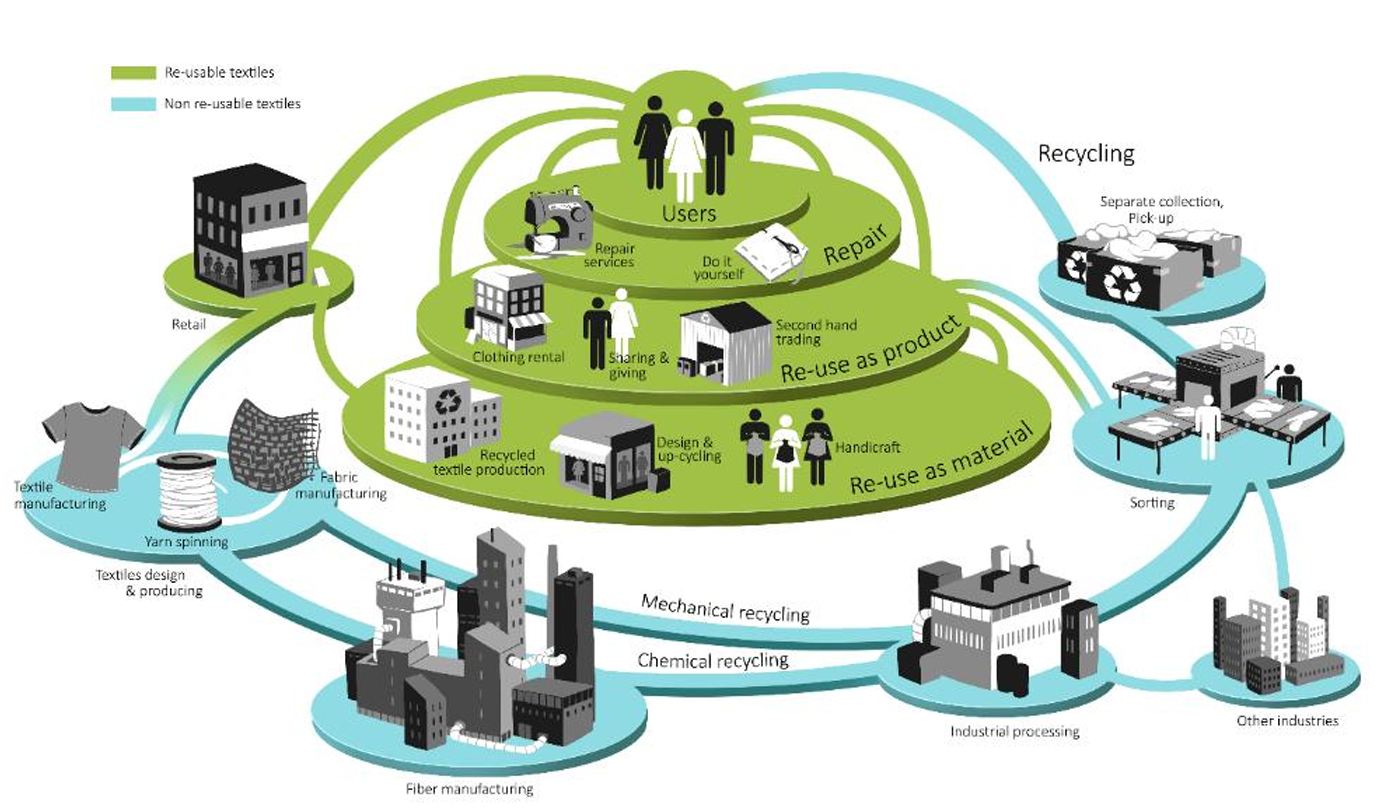
“Figure 9: Model of a circular business ecosystem for textiles” – Withdrawn from Fontell & Heikkilä (2019, p. 20).
This shift involves redesigning the entire ecosystem: designers creating durable and repairable garments, companies adopting more sustainable manufacturing practices, and consumers embracing slower, more responsible fashion choices. Dziubaniuk also emphasized the role of policymakers in steering the sector toward circularity through measures such as digital product passports and extended producer responsibility, which improve product traceability and support waste‑reducing practices. For such collaborations to succeed, actors across the textile ecosystem need common goals of how circularity will be implemented — an essential foundation for long‑term collaboration (Dziubaniuk & Aarikka-Stenroos, 2025).
How to Create Value in Circular Fashion?
A central question for the fashion sector is determining how circular business models can create value. As Dziubaniuk noted, the most effective circular strategies ultimately reduce production and consumption, which conflicts with current economic models built on continuous growth. Shifting toward circularity therefore requires companies to rethink how they create and capture value from circular products and services (Fontell & Heikkilä, 2017). Although this transformation is demanding—requiring changes in consumer behaviour, supportive policies, and new business logic—firms can innovate to develop alternative value‑capture mechanisms. Dziubaniuk illustrated this with a fashion company selling second-hand leather items, inherently avoiding new production, while offering customers a 50% refund as a gift card when they return their items. This model, she explained, is one way to keep both materials and consumers in the loop. As Dziubaniuk noted during the event, “Circular fashion is not only about materials, but also about systems and behavior.”, reiterating the idea that achieving circular fashion requires efforts and collaborations across diverse societal actors to truly “close the loop”.
References
Community Foundation Wakefield District. (n.d.). Fast fashion is killing our planet. Wakefield Community Foundation. https://wakefieldcf.org.uk/case-study/fast-fashion-is-killing-our-planet
Ellen MacArthur Foundation. (2024, June 14). Reducing fabric waste with EPR for textiles & fashion. https://www.ellenmacarthurfoundation.org/epr-policy-for-textiles
Fontell, P., & Heikkilä, P. (2017). Model of circular business ecosystem for textiles. VTT Technical Research Centre of Finland. https://cris.vtt.fi/en/publications/model-of-circular-business-ecosystem-for-textiles
Ermini, C., Visintin, F., & Boffelli, A. (2024). Understanding supply chain orchestration mechanisms to achieve sustainability-oriented innovation in the textile and fashion industry. Sustainable Production and Consumption, 49, 415–430. https://doi.org/10.1016/j.spc.2024.07.008
Dziubaniuk, O., & Aarikka-Stenroos, L. (2025). Ethical value co-creation in circular economy ecosystems: A case study of the textile industry. Journal of Business & Industrial Marketing, 40(6), 1423–1438. https://doi.org/10.1108/JBIM-04-2024-0288
Notes
[i] Organised by Sustainability Community Finland and funded by the Sustainability Action Booster Grant