
We’re delighted to share that Lin has published a new peer-reviewed journal article in the Journal of Healthcare Informatics Research. Her paper titled “Stress and Emotion Open Access Data: A Review on Datasets, Modalities, Methods, Challenges, and Future Research Perspectives” offers an insightful and timely contribution to emotion recognition in eHealth systems: https://link.springer.com/article/10.1007/s41666-025-00200-0
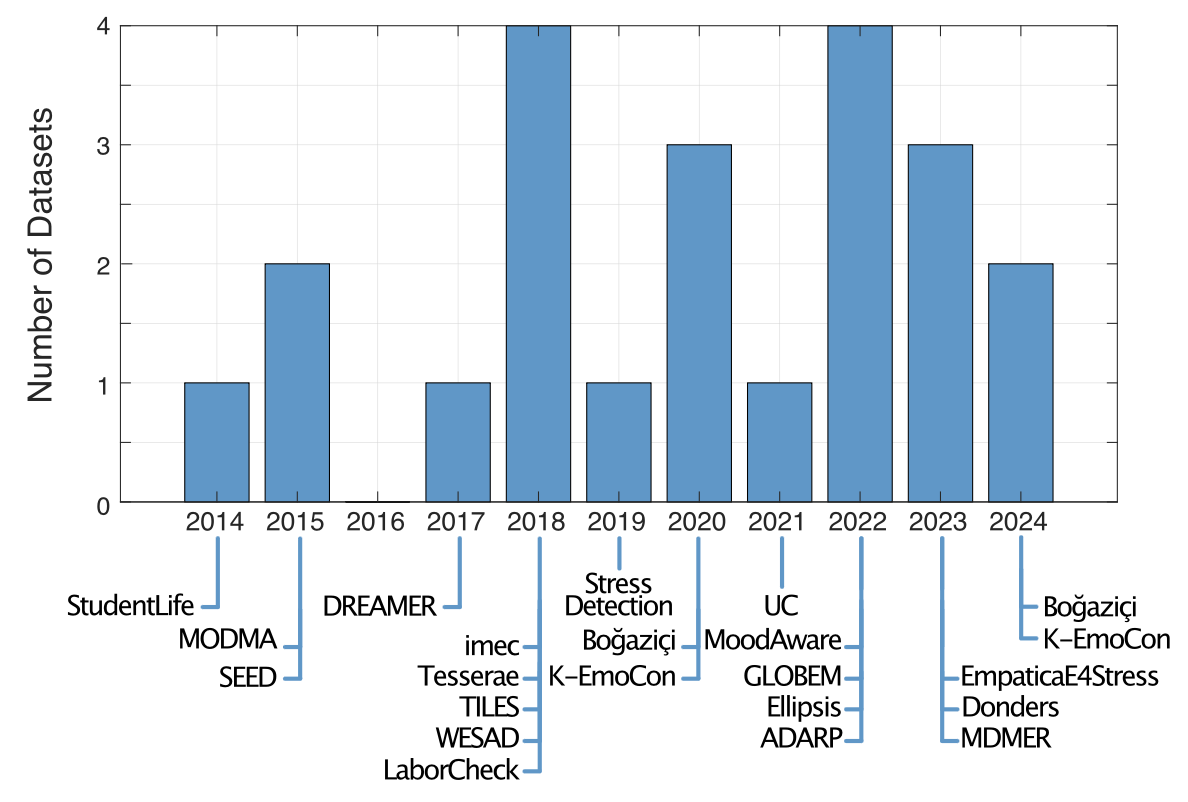
As wearable sensors and remote health monitoring become increasingly central to healthcare innovation, correctly interpreting emotional and stress signals from physiological data is essential. This study reviews publicly accessible multimodal datasets, including heart rate, skin conductance, facial expressions, and more, highlighting advances in data acquisition and algorithm development as well as ongoing challenges such as real-world variability and individual differences in emotional response.
Importantly, the paper outlines critical gaps in current research, such as inconsistent dataset standards and limited validation methods, and presents a future research agenda aimed at achieving scalable, reliable, and privacy-aware emotion detection in practical healthcare applications.
Abstract
Remote continuous patient monitoring is an essential feature of eHealth systems, offering opportunities for personalized care. Among its emerging applications, emotion and stress recognition hold significant promise, but face major challenges due to the subjective nature of emotions and the complexity of collecting and interpreting related data. This paper presents a review of open access multimodal datasets used in emotion and stress detection. It focuses on dataset characteristics, acquisition methods, and classification challenges, with attention to physiological signals captured by wearable devices, as well as advanced processing methods of these data. The findings show notable advances in data collection and algorithm development, but limitations remain, e.g., variability in real-world conditions, individual differences in emotional responses, and difficulties in objectively validating emotional states. Future progress in the field will require privacy‑preserving data strategies and interdisciplinary collaboration to develop reliable, scalable systems.