

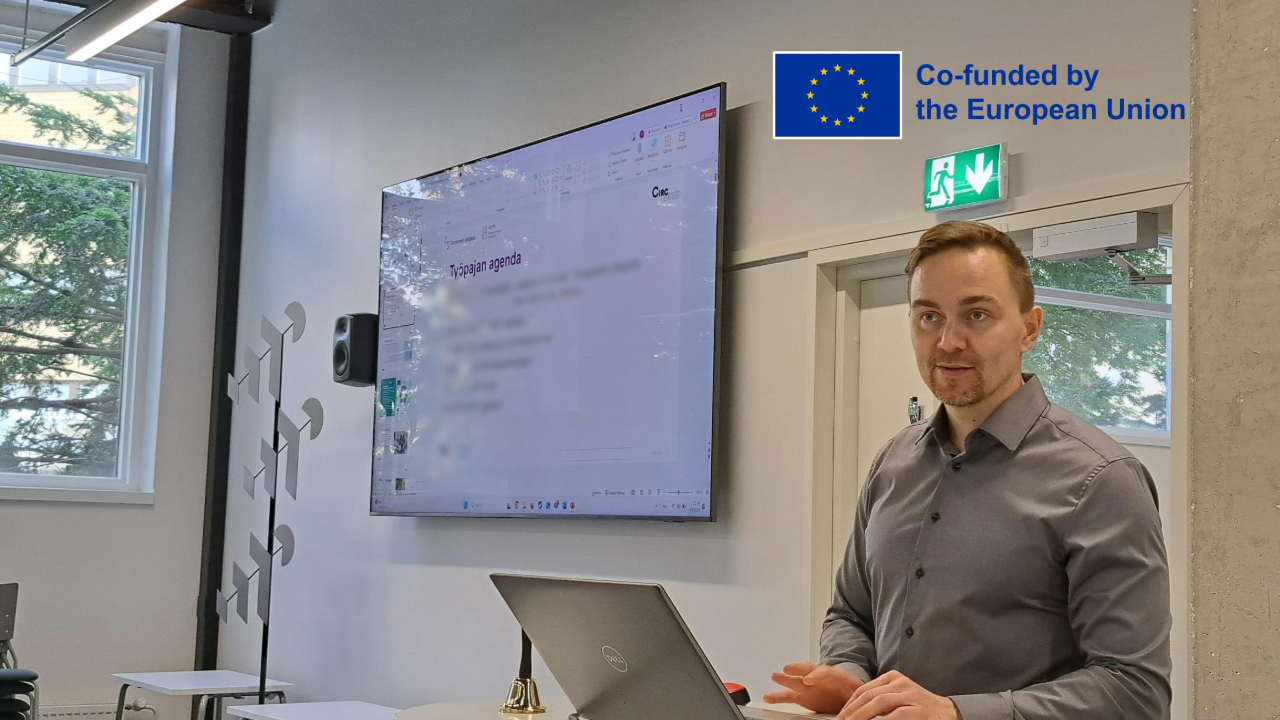
The pilots provide information on circular economy features that interest companies
The workshop “Pilots of circular economy solutions in residential and renovation construction – How to turn successes into established practices?” presented three of the six pilots of the CircBuild project. During the project, pilots will be carried out on different topics for each business partner. The first pilots focus on promoting low-carbon solutions in renovation projects, the reuse of building components, and cooperation between the client and the construction product manufacturer at the renovation site.
The Foundation for student housing in the Helsinki region (Hoas) pilot site has been studied previously as a part of a course at Tampere University. The Kiertotalous korjausrakentamisessa report, which compiles the students’ course work, can be found in the publication archive Trepo in Finnish.
HAMK has studied nationwide distribution of construction elements in Finland
The mapping and further use of building components from demolished buildings has been studied in HAMK’s Digipurku and Second Hand PRO Market projects. There is even an example of a national and international operating model for the reuse of building components, which meets the requirements of storage, certification, logistics and trade in the City of Forssa.
“The participants strongly felt that the circulation of reusable building parts is primarily local, in other words, the part is not physically moved long distances. However, the availability and technical information of these parts, as well as the possibilities of reuse and its prerequisites, should be compiled in a national data bank in order to develop the operations efficiently,” says Research Manager Olli Koskela from HAMK.
According to him, reuse should be the primary goal in terms of environmental impacts. Only after this should recycling the material be considered, even though there are already effective solutions for recycling.
What should the CircBuild project study?
The CircBuild project was interested to find out how familiar and useful the pilots are to the participants when looking at the future of real estate and construction industry. At the same time, we listened to the views of experts from cities, companies and other organisations from the real estate and construction industry on low-carbon solutions, the demolition of buildings, the reuse of building components and the markets for building components.
“Together in the research group, we compiled a list of claims, that the participants were asked to access for accuracy. Our themes were: low-carbon, demolition and reuse of building components, and the market for building components,” says Juha Franssila, a doctoral researcher at Tampere University.
Franssila praised how the participants openly shared their own views and even differing perspectives on some of the claims.
“The workshop clearly clarified the project group’s views on our research theme, and we received valuable guidance for our next steps,” Franssila continues.
Find out about our next steps and the CircBuild project on our website.
For more information, please contact:
Jaakko Kinnunen
Project Manager, CoreLab
Faculty of Built Environment, Tampere University
jaakko.kinnunen@tuni.fi
Olli Koskela
Research Manager, HAMK Tech
Häme University of Applied Sciences, HAMK
olli.koskela@hamk.fi
Text:
Alisa Hakola
Communications and Research at CoreLab
Faculty of Built Environment, Tampere University
alisa.hakola@tuni.fi
The project is co-funded by the European Union and the South Savo ELY Centre. Additionally, the project is funded and partnered by A-Kruunu Oy, Hartela-Yhtiöt Oy, Helsinki Region Student Housing Foundation (Hoas), Real Estate Education Foundation (Kiinko), Saint-Gobain Finland Oy, and Y-Foundation.